Here is an article created based on the reference content you provided.
Semiconductor Industry Embraces Cyclical Recovery: Demand Rebound, Domestic Substitution, and Growth Potential Re-released
Keywords: Semiconductor industry, cyclical recovery, demand rebound, domestic substitution, new quality productivity, market growth
In recent years, the semiconductor industry, as a typical representative of high-tech sectors, has received strong national support and policy preference, as well as active investment from local governments. In the A-share market, the semiconductor sector has shown a clear trend of demand recovery and upward cycle. Industry experts point out that the global semiconductor industry is in a sustained recovery channel, and listed companies across the industry chain are expected to usher in new growth opportunities. This recovery wave is not only a correction of the past downturn cycle but also heralds the beginning of a new round of technological innovation and market expansion.
Clear Demand Rebound Trend
Entering 2024, the semiconductor industry's recovery signals have become increasingly clear. The latest report from the World Semiconductor Trade Statistics (WSTS) shows that in the third quarter of 2024, the global semiconductor market size grew to $166 billion, up 10.7% from the second quarter. This data strongly demonstrates that the global semiconductor market is on a strong recovery track, steadily moving into a new upward cycle.
This trend is vividly reflected in the financial reports of listed companies. In the first half of 2024, 57 companies in the semiconductor industry saw net profit increase nearly 200% year-on-year. Among them, 10 companies had half-year net profit forecasts exceeding 4 billion yuan, with Naura and Will Semiconductor, two industry leaders, performing particularly prominently, with net profits of 2.96 billion yuan and 1.408 billion yuan respectively. Naura's latest third-quarter financial report continues to confirm this recovery trend, with third-quarter operating revenue of 8.018 billion yuan, up 30.12% year-on-year; net profit reaching 1.682 billion yuan, up 55.02% year-on-year. Similarly, SMIC, the world's third-largest chip foundry, released encouraging third-quarter results, with single-quarter operating revenue of 15.6 billion yuan, up 32.5% year-on-year; net profit of 1.06 billion yuan, up 56.5% year-on-year. These data all send strong signals of industry recovery to the market.
In this regard, Liu Xingliang, a member of the Information and Communication Economy Expert Committee of the Ministry of Industry and Information Technology, analyzed: "The global semiconductor market has shown signs of cyclical recovery, with demand rebound, profit growth, and market size improvement forming a positive cycle." He further explained that since 2023, as the impact of the pandemic on global supply chains gradually eased, the problem of high inventory in the semiconductor industry has been effectively resolved, downstream companies have begun to restock, and demand for consumer and industrial electronic products has rebounded significantly, with the recovery trend basically established. Geng Zheng, chief analyst of the electronics industry at GF Securities, also holds the same view, stating: "The electronics industry exhibits typical cyclical growth characteristics, with the recovery in the first half of 2024 particularly significant. Benefiting from the gradual industry recovery, the rapid growth of AI training and inference demand has driven corresponding chip demand high, coupled with the inventory destocking cycle nearing its end, the electronics industry's prosperity has clearly entered an upward channel, with global semiconductor sales recovering year-on-year."
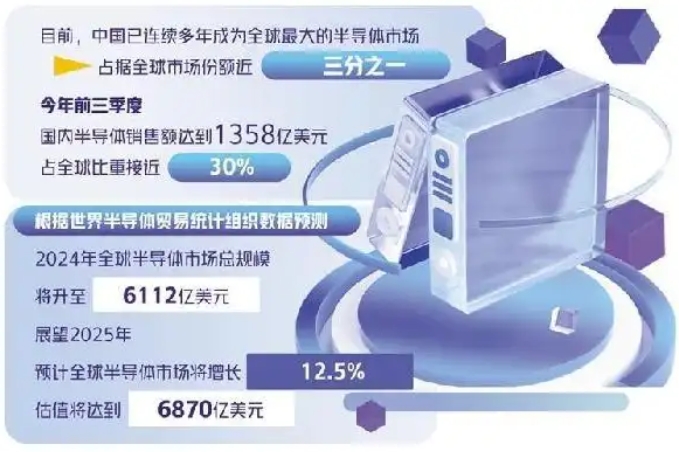
It is worth noting that China has been the world's largest semiconductor market for many years, accounting for nearly one-third of the global market share. In the first three quarters of 2024, domestic semiconductor sales reached $135.8 billion, accounting for nearly 30% of the global share. The government has maintained strong support for the semiconductor industry through multi-dimensional measures such as industrial policy support, tax incentives, and talent cultivation system construction, steadily promoting the scale and high-end development of local semiconductor manufacturing and supporting industry chains.

Image caption: Advanced wafer manufacturing equipment is a core link in the semiconductor industry chain, and its localization process directly relates to the industry's self-control capability.
Multiple securities firms have shown a positive and optimistic attitude toward the semiconductor sector. Guojin Securities stated that the active inventory destocking cycle has ended, and in 2024, the semiconductor industry has shown clear upward cycle signals. The overall supply-side adjustment is basically in place, and as demand steadily recovers, chip prices are expected to bottom out and rebound, with the semiconductor industry chain about to start a new upward channel. Guoxin Securities emphasized in its research report that the sustainability of the semiconductor market should be viewed optimistically. It believes that with the formation of a "policy bottom" in the market, the hard-tech sector, under the policy orientation of "balancing stable growth and structural adjustment," possesses dual characteristics of "economic pro-cyclicality" and "new quality productivity," and semiconductors have become one of the most consensus-driven industry sectors in the market.
Accelerated Domestic Substitution
The strong performance of the semiconductor sector is driven by two main factors. First, the inherent demand for technological innovation. Many investment institutions and individual investors are confident in the future development of the tech industry, viewing semiconductors as a key cornerstone of technological innovation and industrial upgrading, prompting large amounts of capital to actively flow into the tech sector. Second, the complexity of the external environment also provides opportunities for the semiconductor sector's development.
Facing uncertainties in the international supply chain, the strategic importance of domestic substitution for semiconductor equipment and materials has become increasingly prominent, becoming a market focus. Driven by national strategy and market demand, investors generally see the long-term growth potential brought by domestic substitution and invest in this area, expecting to share the fruits of technological self-reliance. CITIC Securities clearly pointed out that the expansion of China's semiconductor domestic demand market and achieving self-reliance have become clear and definite development directions. CITIC Securities further believes that external "neck-jamming" strategies in advanced technology fields cannot change the long-term direction of China's semiconductor industry moving toward high-end development; instead, they will accelerate the domestic industry's self-reliance process. Cinda Securities analyzed from a medium- to long-term perspective, stating that this will force global supply chain restructuring, not only increasing domestic demand for advanced process capacity but also effectively promoting key technological breakthroughs in upstream semiconductor equipment and materials.
Mr. Liu Xingliang also emphasized: "The adjustment of the international semiconductor market supply chain provides a rare 'curve overtaking' opportunity for domestic companies." He pointed out that the global trend of "de-risking" and localized manufacturing has led countries to increase investment in their local semiconductor industries. At the same time, a series of stable growth measures introduced by China have effectively stimulated domestic demand and promoted the recovery of related industry chains, further boosting semiconductor demand overall. Analyst Geng Zheng believes: "In the future, the space for domestic substitution remains vast, and domestic semiconductor companies are expected to continue benefiting from the deepening of the domestic substitution process." He summarized: "Domestic substitution in semiconductors is steadily advancing, showing a development pattern from point to surface and from easy to difficult. From consumer electronics to industrial control and automotive-grade products, from chip design to manufacturing and equipment, local manufacturers are continuously increasing R&D investment, achieving technological breakthroughs, and expanding their growth boundaries."
Further Release of Growth Potential
Looking ahead, industry insiders generally believe that the growth trend of the semiconductor sector is likely to continue. Mr. Liu Xingliang stated: "New quality productivity emphasizes knowledge intensity, technological leadership, and resource conservation, and the innovative development of the semiconductor industry is highly aligned with this concept." He further explained that the semiconductor industry itself is a key area of new quality productivity, representing the core driving force in economic structural transformation. It not only improves the operational efficiency of traditional industries but also fosters new economic forms such as smart manufacturing, autonomous driving, and smart cities. As downstream demand from AI chips, automotive electronics, and smartphones continues to expand, the growth potential of the semiconductor industry is expected to be further released.
According to the World Semiconductor Trade Statistics (WSTS) forecast, the global semiconductor market size will climb to $611.2 billion in 2024. Looking ahead to 2025, the market is expected to continue growing by 12.5%, with a total valuation expected to reach $687 billion. In the long term, the market generally believes that the favorable outlook for the semiconductor industry will not fundamentally change. Cinda Securities stated that the country is continuously strengthening policy support for technological innovation, providing a solid development guarantee for companies with strong tech attributes. The semiconductor industry, with its strong tech attributes, is an important part of developing new quality productivity. Currently, with the increasingly clear recovery trend of the semiconductor industry, coupled with continued national policy support, the semiconductor industry presents significant long-term investment opportunities.
At a more specific enterprise level, SMIC's third-quarter report provides strong evidence for the industry's optimistic outlook. The report shows that the company added 21,000 12-inch wafers of monthly capacity, which not only promoted further optimization of the product structure but also drove up the average selling price. At the same time, the company's overall capacity utilization rate increased to 90.4%, and gross margin rose to 20.5%. For the fourth quarter, the company's management gave a performance outlook of revenue flat to up 2% quarter-on-quarter, with gross margin maintained between 18% and 20%. Tiantfeng Securities analyzed that the second half of the year is typically the traditional peak season for the semiconductor industry. With the concentrated launch of new consumer electronics models, AI smartphones and AI PCs are expected to be the main highlights of new models this year, coupled with breakthroughs in domestic server development, semiconductor demand is expected to continue recovering, and the growth of domestic semiconductor companies will become more prominent. In SMIC's third-quarter report, the proportion of revenue from China increased by more than 6 percentage points compared to the second quarter, and despite continuous capacity expansion, capacity utilization significantly improved from 77.1% in the same period last year to 90.4%, fully demonstrating the strong resilience of domestic market demand.
CITIC Securities concluded that looking ahead to 2025, the global semiconductor industry scale is expected to continue growing. Among them, the high prosperity trend of cloud computing demand is expected to continue, while the industry looks forward to edge AI becoming a new growth point to further push the semiconductor industry upward. For the domestic semiconductor industry, as the underlying foundation of scientific and technological new quality productivity, driven by multiple positive factors such as policy support, cycle reversal, incremental innovation, and domestic substitution, especially with increasing participation in the edge AI field, the domestic semiconductor industry is expected to achieve better market performance in the next stage. This undoubtedly paints a promising and dynamic future picture for the entire industry.
Conclusion
In summary, the global semiconductor industry is in a new growth cycle driven by demand rebound, deepening domestic substitution, and new quality productivity. Market data, corporate financial reports, and expert opinions all point to a consensus: the industry's cyclical recovery has been established and is accelerating toward a new growth stage. For the Chinese market, accompanied by sustained national policy support, a huge domestic demand market, and a firm path of self-reliance, the domestic semiconductor industry can not only overcome external challenges but also seize historic opportunities brought by emerging application fields such as AI and smart cars. In the future, the growth potential of the semiconductor industry will be further released, injecting inexhaustible momentum into technological innovation and high-quality economic development.