
 <\/div><\/div>
Here is the article based on your provided reference content:<\/p>\n
\n
Leaving the Mobile Comfort Zone: Qualcomm's Full Push into AI Data Centers and Automotive, Targeting $40B Non-Mobile Revenue by 2029<\/h2>\n
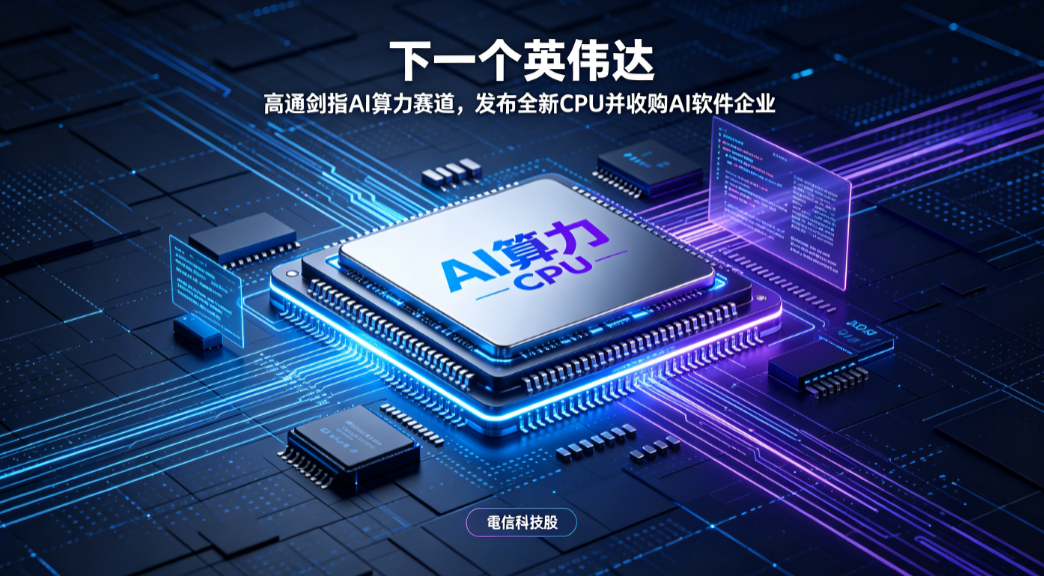
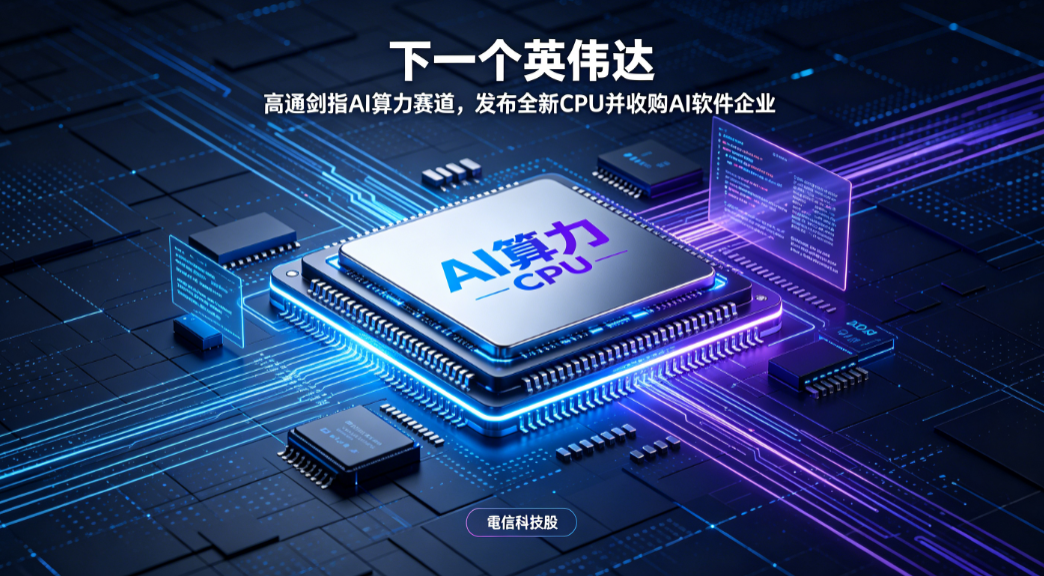
Keywords:<\/strong> Qualcomm, AI Data Center, Dragonfly CPU, Automotive, Modular Acquisition, Non-Mobile Revenue, Energy-Efficient Computing, NVIDIA CUDA<\/p>\n On Wednesday, Qualcomm's Investor Day and shareholder meeting sent its stock up 13% after hours. This was no fleeting market sentiment but a strategic signal from management that could reshape the semiconductor landscape. The core message: Qualcomm is no longer content as the king of smartphone chips; it is boldly launching a well-prepared full-scale assault on the trillion-dollar AI data center and automotive markets.<\/p>\n At the meeting, Qualcomm unveiled an unprecedented financial vision: raising its fiscal 2029 non-mobile revenue guidance from the previous $22 billion to $40 billion, an increase of nearly 91%. This is not just a revenue jump but a shift from a single "mobile-first" engine to a diversified flywheel of "data center + automotive + mobile." However, whether this transformation is as grand as executives portrayed requires deep analysis of its strategic logic, technology foundation, and market timing.<\/p>\n For years, Qualcomm was known as the king of Snapdragon processors, dominating high-end smartphones. But global smartphone shipments peaked in 2017 and have since slowed. Qualcomm knows it must look beyond mobile. At this shareholder meeting, Qualcomm officially declared its ambition: moving from edge AI (phones, PCs) into cloud AI data centers.<\/p>\n Dragonfly C1000 Lands, Meta First to Deploy<\/strong><\/p>\n The most anticipated hardware was the data center processor Dragonfly C1000. Qualcomm stressed the chip was designed for emerging "autonomous agentic AI" workloads. Unlike traditional LLM training, autonomous AI agents require real-time, efficient inference and decision-making, demanding high CPU responsiveness and low power.<\/p>\n Dragonfly C1000's core advantage is not peak theoretical performance but a perfect balance of high performance and ultra-low power. Qualcomm revealed that Meta will massively deploy Dragonfly C1000 once mass production begins in 2028, with a long-term supply agreement. This partnership provides critical market validation and directly competes with in-house chips from cloud giants.<\/p>\n Qualcomm CFO Akash Palkhiwala noted the market need: "CPU supply is insufficient; the industry needs more capable players." This highlights Qualcomm's entry point: as AI workloads shift from pure GPU training to hybrid inference, CPU importance resurfaces, and few suppliers can deliver high-performance, energy-efficient server CPUs.<\/p>\n To skeptics asking if Qualcomm is late to data centers, CEO Cristiano Amon responded confidently: "Entry timing isn't just about time; it's about scale, execution capability, engineering strength, and supply chain completeness." Qualcomm is not starting from scratch; its years of work in edge computing, AI acceleration, and 5G have paved the way.<\/p>\n "Energy efficiency" is Qualcomm's sharpest tool. With Moore's Law slowing and data center power consumption rising exponentially, electricity is a key bottleneck for hyperscalers. Qualcomm's expertise in making smartphone and PC chips that extend battery life precisely meets cloud providers' need for power savings.<\/p>\n Deep power management technologies from mobile chips, such as dynamic voltage/frequency scaling and advanced process selection, can be transferred directly to server chip design. Compared to NVIDIA GPUs and Intel Xeon processors, Qualcomm's solutions may not lead in absolute compute but excel in performance per watt. For cloud providers, lower energy costs mean higher margins, making Qualcomm's energy-efficient chips an option they cannot ignore.<\/p>\n In addition to AI data centers, Qualcomm raised its automotive mid-to-long-term target, forming a "dual-engine" growth pattern. Qualcomm set a 2029 automotive revenue target of $10 billion, with its design win pipeline already valued at $65 billion.<\/p>\n Qualcomm's automotive strategy is not hit-and-run but a well-established position. Through the Snapdragon Digital Chassis platform, it covers smart cockpits, in-vehicle infotainment, ADAS, and connected cars. As vehicles become more electrified and intelligent, per-car chip value increases significantly. Qualcomm's deep expertise in mobile communications and computing makes it a preferred partner for many automakers.<\/p>\n By 2029, data center and automotive will contribute over half of Qualcomm's non-mobile revenue, fundamentally reducing its dependence on mobile and building a more resilient revenue structure.<\/p>\n Hardware is only part of the equation. Qualcomm knows software ecosystem is critical in the AI era. It announced the acquisition of AI software startup Modular for about $3.92 billion in stock. This deal signals Qualcomm's intent to replicate NVIDIA's moat built with CUDA.<\/p>\n Modular's core assets: the Mojo programming language, MAX inference platform, and AI compiler toolchain. This software enables AI applications to run efficiently across multiple chip architectures (GPU, CPU, NPU), greatly reducing deployment difficulty. For Qualcomm, this fills a crucial gap in its AI infrastructure.<\/p>\n Previously, Qualcomm's AI software toolchain was relatively closed, mainly serving the mobile ecosystem. With Modular, Qualcomm can integrate its technologies into its AI Engine and Adreno GPU, providing a unified, easy-to-use, efficient development environment for data center and automotive customers. This is NVIDIA's long-standing winning formula: deep hardware-software coupling creating sticky customer relationships. Qualcomm aims to make developers as familiar with its ecosystem as they are with CUDA, driving hardware adoption in AI applications.<\/p>\n Qualcomm's 2026 Investor Day was more than an update; it was an ambitious transformation manifesto. It clearly shows the path: leaving the "comfort zone," leveraging "energy efficiency" and "connectivity" to build a full-scenario AI edge-to-cloud loop spanning smartphones, automotive, and data centers.<\/p>\n While Qualcomm faces tough competition from NVIDIA, Intel, and AMD, and Dragonfly C1000 won't be mass-produced until 2028, Meta's endorsement, the Modular acquisition, and precise automotive positioning paint a clear and executable growth path. The $40 billion non-mobile revenue target may not be just a number; it signals a new variable in the semiconductor landscape. Qualcomm's bold bet is worth watching.<\/p> Introduction: A Long-Awaited Transformation?<\/h3>\n
Main Body<\/h3>\n
1. Strategic Shift: From Snapdragon to Dragonfly, Capturing Server Compute<\/h4>\n
2. Energy Efficiency: Qualcomm's Wedge into Data Centers<\/h4>\n
3. Automotive: The Second Pillar Alongside Data Centers<\/h4>\n
4. Acquiring Modular: Software-Hardware Synergy Against NVIDIA CUDA<\/h4>\n
Conclusion:<\/h3>\n