
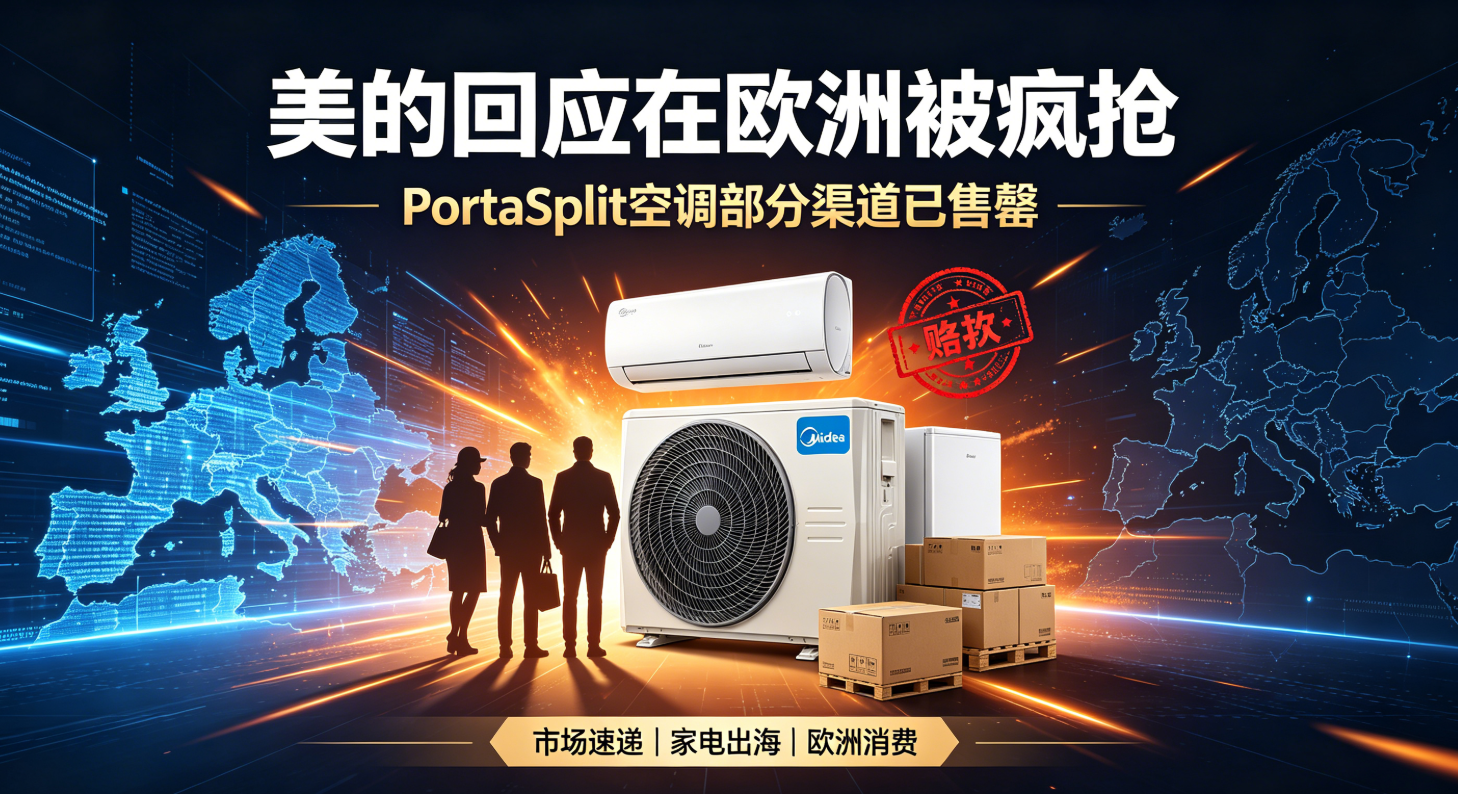
Europe's Heatwave Drives Chinese Air Conditioner Sales: Midea PortaSplit in High Demand, Hidden Market Shifts Behind
Keywords: Europe heatwave, Chinese home appliances, Midea PortaSplit, portable air conditioner, market share, installation barriers
Introduction
In the summer of 2026, continental Europe experienced an unprecedented extreme heatwave, with temperatures hitting new highs in Spain, France, Germany and other regions, even approaching a historical extreme of 45°C in some areas. Faced with the scorching heat, European households, which have long had an extremely low air conditioner penetration rate, had to turn to alternative solutions. Amid this life-saving demand, the PortaSplit portable split air conditioner launched by Chinese home appliance giant Midea Group unexpectedly became a hot commodity in the European market. On social platforms, from lamentations of German consumers that all stores within a 100-kilometer radius were sold out, to tech enthusiasts building their own inventory-checking websites and launching paid subscription services, to stories of consumers driving 200 kilometers to snap up the last unit at a 100-euro premium, it all underscores how this consumer frenzy triggered by climate change is profoundly reshaping the landscape of the European air conditioner market.

Extreme Climate Ignites Demand, Chinese Air Conditioners Become Lifeline
According to data from the EU climate monitoring agency, since June 2026, maximum temperatures in many European countries have exceeded 40°C, with record highs recorded in France, Spain, Germany and elsewhere. The persistent heatwave not only tests infrastructure, but also forces European households long accustomed to tolerating the heat to rush to buy air conditioners. In an official response to media, Midea Group pointed out: "The heatwave has significantly boosted sales growth, especially for the PortaSplit air conditioner, which has sold out in some sales channels." A set of data corroborates this surge: in the first five months of 2026, China's air conditioner exports to three Western European countries—France, the Netherlands, and Belgium—doubled year-on-year, while exports to Central and Southern European countries like Spain and Germany also achieved double-digit growth. Midea's sales through German e-commerce channels grew about 37% year-on-year, and shipments to Spain and France surged 108% year-on-year respectively.
Installation Barriers Spur Product Innovation, Portable Air Conditioners Become Market Darling
The European air conditioner market has long been sluggish, not due to lack of purchasing power, but structural installation obstacles. Data shows that the household air conditioner penetration rate in Europe is only about 20%, and in Western European countries like Germany and France, it is even below 15%. A large number of urban buildings are listed as historical buildings, with laws explicitly forbidding drilling holes in external walls to install air conditioner outdoor units; installing in ordinary apartments requires approval from the homeowners' association, a process that takes months and often faces opposition from neighbors; coupled with high labor costs, a single installation by a certified technician typically costs between 1,000 and 2,000 euros, far exceeding the price of the air conditioner unit itself. These bottlenecks force consumers to turn to portable air conditioners that require no complex installation and can be flexibly moved.
Midea's PortaSplit adopts a window-mounted external design, allowing users to assemble it within 10 minutes without professional construction. Its official price in Germany is about 699–900 euros, but after sellouts, scalpers have driven it up to 1,500–5,000 euros (approximately RMB 12,000 to 40,000), a premium of several times. This "buy-and-use" product feature precisely hits the pain points of European consumers, making it the hard currency of this summer.
Chinese Brands' Market Share Jumps, Capital Market Reacts Enthusiastically
According to disclosures from Midea's overseas business head, in the first half of 2026, Midea's overall air conditioner sales in Western European markets such as Germany, France, Spain, and the UK grew over 70% year-on-year, with the PortaSplit single product selling more than 60,000 units in the German market in half a year, and expected annual sales of 200,000–300,000 units across Europe. This is not only a victory for Midea, but also represents the collective rise of Chinese air conditioner brands in Europe. Data from the General Administration of Customs of China shows that in the first half of 2026, China's air conditioner exports to the EU reached $3.76 billion, up 43.2% year-on-year, a record high for the period. Among them, exports of installation-free mobile air conditioners surged over 70% year-on-year, making it the fastest-growing segment.
A related person from Gree Electric also told media that from January to June 2026, actual air conditioner sales in France, Italy, Spain and other countries grew over 40% year-on-year. Brands such as Midea, Gree, Haier, and TCL have achieved significant gains in the European market with portable air conditioners, with Chinese brands' market share jumping from 27% in 2023 to 41%, becoming Europe's largest source of air conditioner supply for the first time. This surge directly transmitted to the capital market: on June 29, Midea's A-share rose nearly 3%, with a total market value of about 528 billion yuan; its Hong Kong shares surged over 5%, with a total market value of about 642.6 billion HKD. Gree Electric rose over 2%, Hisense Home Appliances rose nearly 5%, and the home appliance sector overall outperformed the broader market.
Conclusion: Climate Change and Product Innovation Jointly Shape Future Market
The European heatwave is not only a climate crisis, but also a mirror reflecting the huge pent-up demand in the traditional air conditioner market due to installation barriers. Chinese home appliance companies have keenly captured this structural opportunity, entering the market with installation-free, portable air conditioners, successfully breaking through the long-standing expansion bottleneck in the European market. In the short term, extreme weather will continue to stimulate demand; in the long term, as European countries pay more attention to building energy-efficiency retrofits and consumers pursue comfortable living, Chinese brands with flexible installation advantages are expected to further expand their market share. However, issues such as scalper speculation and supply chain tension also require proactive corporate responses. This air conditioner revolution triggered by a heatwave may only be the beginning of China's home appliances' deep layout in Europe.