
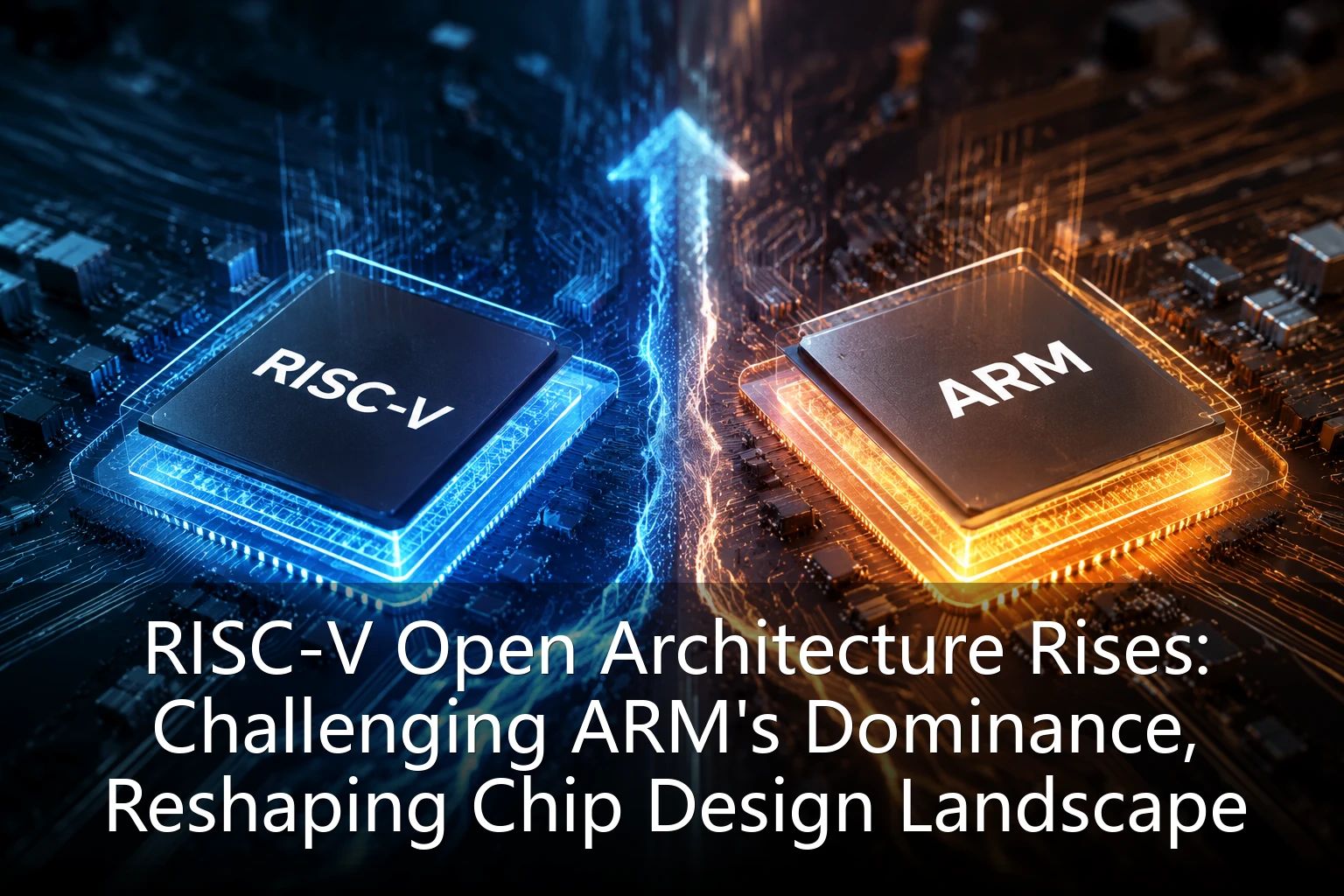
The chip design market, long dominated by x86 and ARM architectures, is facing a strong challenge from open-source forces. RISC-V (Reduced Instruction Set Computing Fifth Generation), with its open, free, and customizable features, has attracted global tech giants including Google, Qualcomm, and Alibaba to actively deploy in recent years. On July 28, 2026, RISC-V International officially released an update to its architecture specification, adding extended instructions for AI inference and automotive functional safety, once again igniting the market's imagination about the future of open-source chips.
Unique Advantages of Open Source Architecture
Unlike ARM's licensing fees and x86's completely closed model, RISC-V uses the BSD license, allowing any company or individual to use, modify, and commercialize it for free. This feature significantly lowers the entry barrier for chip design, making it especially suitable for highly customizable IoT sensors, edge AI processors, and startup chip companies.
According to data released by RISC-V International in the second quarter of 2026, there are over 4,000 member companies worldwide, covering the entire chain from IP design, EDA tools, wafer foundry to system integration. Among them, China, driven by semiconductor self-sufficiency needs, has become the fastest-growing market for RISC-V, with dozens of design service startups focusing on RISC-V cores emerging in Shanghai, Beijing, Shenzhen, and other cities.
Tech Giants Compete to Bet on RISC-V
In July 2026, Google announced at its annual developer conference that the controller of its next-generation TPU (Tensor Processing Unit) will switch to a custom core based on RISC-V, replacing the original ARM Cortex-M series. Google stated that RISC-V's openness allows the team to deeply optimize power and latency, and the absence of licensing fees helps in large-scale deployment of AI infrastructure.
On the other hand, Qualcomm also demonstrated a new Snapdragon automotive cockpit chip integrating a RISC-V microcontroller for managing sensor data and power control. A Qualcomm senior vice president noted that RISC-V's modularity can quickly respond to automakers' strict requirements for functional safety (ISO 26262), and the ecosystem already has multiple certified IP providers.
Alibaba's T-Head Semiconductor launched the third-generation XuanTie series RISC-V processors in 2026, targeting data centers and edge AI servers. T-Head's president stated that the XuanTie 910C has approached the performance of the comparable ARM Cortex-X1 in SPECint benchmarks, with a smaller die area and lower power consumption.
Ecosystem Gradually Matures: Breakthroughs in Software and Hardware
For years, RISC-V was criticized for lacking a mature software ecosystem, especially compilers, operating systems, and development toolchains. But in 2026, a clear turning point emerged. The RISE project (RISC-V Software Ecosystem), led by the Linux Foundation, has ported major Linux distributions (such as Debian and Fedora) to the RISC-V 64-bit architecture and passed kernel driver compatibility tests.
At the EDA tool level, Synopsys and Cadence have both launched full RISC-V-supporting digital design flows by the end of 2025 and obtained process certifications from multiple foundries. This means design teams can directly use industry-standard tools for simulation, synthesis, and physical design, without relying on open-source or self-developed tools as in the early days.
Importantly, RISC-V International's July 2026 architecture specification officially includes the vector extension (V-extension 1.1) and secure isolation extension (Sm3.0). The former provides high-efficiency SIMD instructions for AI and HPC applications, while the latter addresses the need for secure enclaves in IoT scenarios. These updates are seen as direct competition to ARM's Neon and TrustZone.
Challenging ARM's Dominance: Market Share and Future Outlook
Despite rapid progress, RISC-V will still find it difficult to shake ARM's absolute dominance in smartphones and tablets in the short term. ARM's ecosystem, built over 30 years, has millions of compatible apps, and its high-performance cores (e.g., Cortex-X series) still lead RISC-V in single-thread performance. Moreover, ARM is gradually regaining ground in the server space, with NVIDIA Grace and Ampere Computing adopting ARM architecture.
However, RISC-V's growth curve remains steep. Semiconductor research firm IC Insights predicts that RISC-V's share of global CPU core shipments will climb from 6% in 2024 to 18% by 2028, with growth mainly from IoT (MCUs), AI accelerators, and automotive controllers. Especially amid US-China tech decoupling, China's investment in RISC-V will continue to increase, with Chinese RISC-V chip shipments expected to exceed 5 billion units by 2027.
Notably, the risk of RISC-V fragmentation is drawing attention. Some companies (such as China's T-Head and US-based SiFive) have begun launching proprietary extension instructions, which could harm software compatibility. RISC-V International has established a technical working group to develop a unified "RISC-V Profile" to ensure interoperability among different implementations.
Investment Insights: Focus on Beneficiaries of the RISC-V Supply Chain
For investors, the rise of RISC-V brings new opportunities for semiconductor IP design services, EDA software, and specialized chip design companies. Among tech stocks listed on the Singapore Exchange (SGX), professional testing service provider UnaBiz has announced the inclusion of RISC-V in its IoT module reference design; while Xilinx (now part of AMD), which focuses on chip verification, has set up a RISC-V compatibility lab in Singapore.
In the long run, RISC-V could reshape the semiconductor landscape, breaking the duopoly of ARM and x86. Although the ecosystem still has a long way to go, its open spirit aligns with global demands for digital sovereignty and supply chain security. Chip investors should closely watch RISC-V-compatible IP licensors (such as SiFive and Andes Technology) and niche chip companies using RISC-V designs, as they are likely to stand out in the next technology wave.
In summary, RISC-V is gradually penetrating from edge applications to core domains, and the architecture update in July 2026 marks a new phase of technical maturity. As software and hardware bottlenecks in the ecosystem are progressively overcome, this "open-source revolution" in chip design is just beginning.