
Please see the professional article created for you below:
Hawkish Signals Behind Rate Stability: Analyzing the Fed's Latest Decision and Future Policy Path
(Keywords: Federal Reserve, interest rate decision, dot plot, inflation, hawkish, Powell, monetary policy)
Introduction:
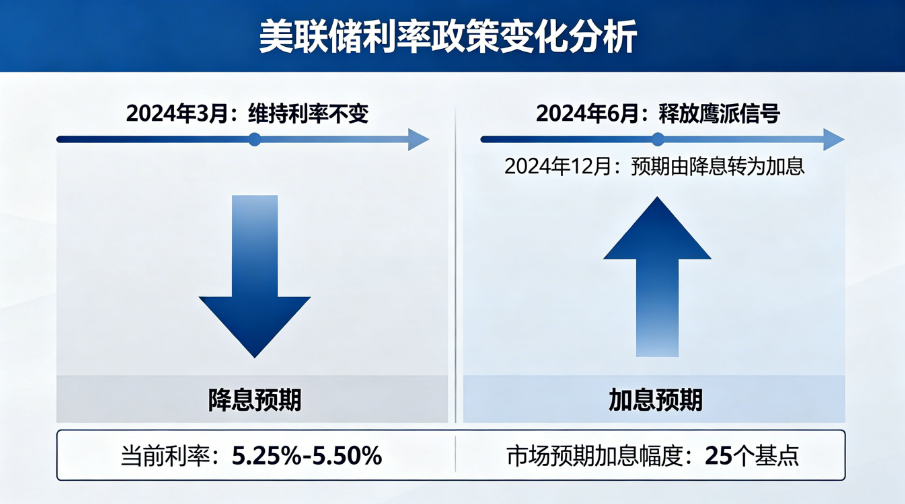
In an atmosphere of global financial market anticipation, the U.S. Federal Reserve (Fed) concluded its two-day Federal Open Market Committee (FOMC) meeting and announced it would hold the federal funds rate target range steady at 3.5% to 3.75%. This decision, as widely expected, marked the fourth consecutive time the Fed has held steady, and it has now been more than six months since its last rate cut in December 2025. At first glance, the decision to 'freeze' rates is nothing new. However, the various signals released from this meeting—from a significantly streamlined policy statement to a clearly hawkish interest rate dot plot—have stirred waves beneath a calm surface, revealing a major shift in the Fed's internal attitude toward the future monetary policy path. A 'higher for longer' hawkish mindset seems to be resurging. This article will delve into the key content of this decision, interpret its policy implications, and anticipate its potential impact on global financial markets.
I. Policy Statement: Implications in the Streamlined Text
The most striking feature of the policy statement released after this FOMC meeting is its notable reduction in length. According to data, the full text of this statement is only about 130 words, far fewer than the 340 words from the April meeting. The statement content has been drastically simplified, with only two paragraphs describing economic conditions and even omitting the list of voting members. This is not unintentional; as 'Fed whisperer' Nick Timiraos pointed out, it marks a significant change in the meeting's communication framework.
This streamlined, less detailed style of expression may convey several layers of meaning. First, it shows that the Fed's decision-makers have become more unified in their interpretation of the current economic environment, no longer requiring lengthy text to balance internal disagreements. Second, it could be a strategic adjustment intended to reduce excessive guidance to the market, avoiding financial markets' microscopic overinterpretation of every word in the statement. However, simplification does not mean vagueness; the retained key wording still releases clear signals.
The statement reaffirmed the Fed's dual mandate and basic assessment: U.S. economic activity continues to expand at a solid pace, employment growth and labor force size remain in sync, the unemployment rate is little changed, and productivity growth and capital investment are strong. This confirms the consistently optimistic tone regarding the economic fundamentals. However, on the inflation issue most concerning to the market, the statement explicitly noted that 'inflation remains above the Committee's 2% target' and attributed part of the reason to 'supply shocks pushing up prices in some sectors, including energy.' This effectively acknowledges the stubbornness of recent inflation data and leaves room for future policy tightening.
II. Hawkish Shift in the Dot Plot: From Rate Cut Expectations to Rate Hike Possibility
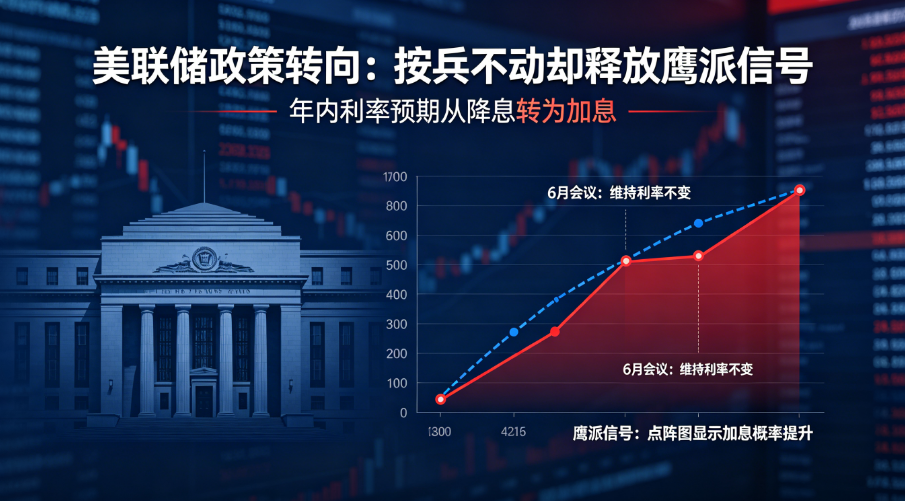
If the policy statement was a gentle breeze, the simultaneously released Summary of Economic Projections, especially the interest rate dot plot, was nothing short of a sledgehammer, completely overturning market expectations that the Fed was about to pivot toward easing. The dot plot showed that the median projection for the federal funds rate at the end of 2026 among 18 Fed officials is 3.75% to 4%, a stark contrast to the 3.25% to 3.5% forecast in March. Simply put, the collective view of officials made a sharp U-turn from 'one rate cut this year' to 'one rate hike this year.'
More aggressive is the distribution behind the dot plot. Data shows that the number of officials who believe three rate hikes should occur in 2026 increased from zero in March to one, and those favoring two rate hikes increased from zero to five. This means that among the 18 policymakers, as many as nine predict at least one rate hike this year, with six of them even expecting multiple rate hikes. In stark contrast, only one official expects a rate cut this year. This overwhelming hawkish consensus undoubtedly threw cold water on market participants who expected the Fed to ease policy soon.
Furthermore, for longer-term rate projections, the dot plot also showed an overall upward trend. Officials' median rate projections for the end of 2027 and 2028 were all higher than their March forecasts. This further confirms that the Fed internally believes the current interest rate level—a range well above the norm of the past decade—needs to be maintained for a longer period to fully tame inflation.
III. Economic Projections: Stubborn Inflation, Slowing Growth?
In addition to rate projections, this Summary of Economic Projections also reflects Fed officials' views on the future macroeconomic outlook. On economic growth (GDP), officials revised down the median projection for 2026 GDP growth from the previous 2.4% to 2.2%, indicating a downward adjustment in expectations for the pace of future economic expansion. The unemployment rate projection remained essentially unchanged, staying at a low level around 4.3%.
The most critical change came from inflation projections. Officials raised the median projection for this year's (2026) PCE inflation rate significantly from 2.7% in March to 3.6%; the core PCE inflation rate projection was also notably raised from 2.7% to 3.3%. This surprisingly large upward revision directly reflects the pressure from recent inflation data consistently exceeding expectations. Even projections for 2027 and 2028 were also slightly revised upward, indicating the Fed expects the process of returning to the 2% target to take longer and be more winding.
Notably, the one-time upward revision of the 2026 inflation projection corroborates the statement's mention of 'supply shocks in the energy sector' and also creates a certain tension with some Fed officials' views that the AI investment boom could push inflation down. This shows that uncertainty about the inflation path remains within the Fed, but the current consensus is clearly that 'inflation is more stubborn than expected.'
IV. Market Reaction and Future Outlook
As soon as this hawkish-toned policy statement and dot plot were released, they immediately sparked strong reactions in financial markets. The U.S. dollar index (DXY) rose notably after the release of the economic projections, indicating heightened market expectations for the Fed to maintain high rates or even hike further; safe-haven assets like spot gold fell briefly, reflecting changes in capital flows. Bond markets, especially short-term Treasury yields, also rose in response.
Overall, this Fed meeting marks an important policy inflection point. It establishes that, until there is significant and sustainable evidence of declining inflation, the Fed will not hesitate to maintain a tight stance, even using 'rate hikes' as a final tool to combat stubborn inflation. This is not merely a simple adjustment of interest rate decisions but a recalibration of the entire monetary policy communication framework.
Looking ahead, the market's focus will shift to the following aspects:
- Data-dependent path: The Fed promises future policy decisions will depend on overall economic data. Therefore, key data in the coming months—such as CPI, PCE, and nonfarm payrolls—will be the most direct basis for determining whether the Fed will start raising rates in the second half of 2026.
- Subsequent remarks by Powell: Although there was no press conference at this meeting, public speeches by Fed Chair Powell and other committee members in the coming weeks will be important windows for the market to interpret policy details and gauge policymakers' true intentions.
- Challenges to the 'soft landing' outlook: The downward revision of growth expectations coupled with upward revision of rate expectations undoubtedly adds new challenges to the goal of a 'soft landing' for the U.S. economy. Balancing inflation suppression and labor market stability will be a major test for the Fed.
Conclusion:
Behind the decision to 'hold steady' on rates is a clear warning from the Fed about stubborn inflation and a hawkish hint of future policy tightening. Through a streamlined statement and a dramatically shifted dot plot, the Fed clearly conveyed to the market the signal, 'We have not yet won; we must remain vigilant.' For global investors, a new macro environment with higher rates, possibly for a longer duration, is taking shape. As the music of rate cuts abruptly stops and the prelude to rate hikes faintly sounds, market participants must adjust their asset allocation and risk management strategies to adapt to this new era defined by 'higher for longer.' The Fed's move not only concerns the future of the U.S. economy but will also profoundly affect the direction of global capital markets. And we are only beginning to feel the power of this hawkish storm.