
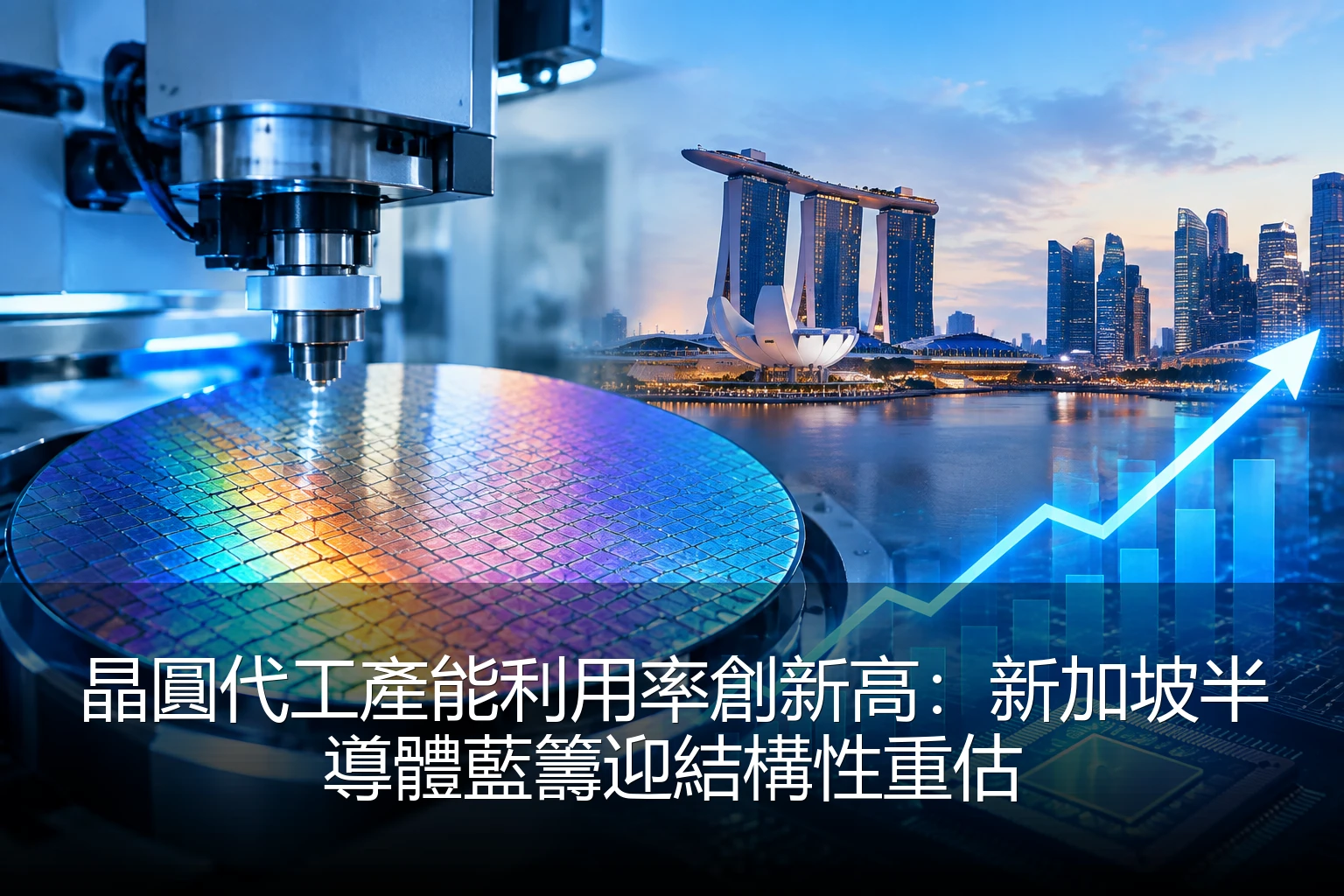
Record High in Wafer Fabrication Capacity Utilization: Singaporean Semiconductor Blue Chips Undergoing Structural Revaluation
As the global semiconductor industry reaches a recovery inflection point, wafer fabrication capacity utilization has hit a near two-year high, positioning Singaporean semiconductor blue chips at a historic turning point. Against the backdrop of the AI technology wave sweeping the globe, Singapore, a vital hub in the Asia-Pacific semiconductor industry, is not only reshaping the industry ecosystem through wafer fabrication capacity expansion and technological upgrades but is also presenting structural revaluation opportunities for investors. This article will deeply analyze the current changes in the wafer fabrication industry landscape, interpret the investment value of Singaporean semiconductor blue chips, and look ahead at the capacity revolution driven by AI.
Record High Capacity Utilization: A Signal of the Semiconductor Cycle Turning
Industry data indicates that global wafer fabrication capacity utilization reached 89.7% in the third quarter of 2026, the highest in nearly two years, marking a significant 13.5 percentage point increase from 76.2% in the same period of 2025. This figure not only signifies that the semiconductor industry has officially moved past the inventory adjustment phase but also foreshadows a structural shift in global chip demand.
Singapore's semiconductor industry has shown particular strength amid this rebound in capacity utilization. The capacity utilization rate of Singaporean wafer fabs has reached 91.2%, surpassing traditional semiconductor powerhouses like Taiwan and South Korea to rank number one globally. Behind this phenomenon is the proactive strategic planning of the Singaporean government in semiconductor industry policy, coupled with the accurate forecasting of AI chip demand by wafer fabrication manufacturers.
AI-Driven Capacity Revolution: Expansion Strategies of Singaporean Wafer Fabs
The rapid development of artificial intelligence technology, especially the proliferation of generative AI and large model training, is leading to an exponential increase in the demand for high-performance computing chips. Market research institutions predict that the global AI chip market size will exceed $150 billion in 2026, with an annual growth rate as high as 38%. This demand wave is directly driving the expansion of wafer fabrication capacity.
Major Singaporean wafer fabrication companies have actively responded to this trend. TSMC Singapore has announced investments exceeding $10 billion to expand advanced process capacity, focusing on AI chip production using 7nm and below processes. Furthermore, GlobalFoundries has initiated a new 12-inch wafer fab construction project in Singapore, specifically to support high-performance computing and AI applications.
The Singaporean government is also strongly supporting this capacity expansion. Through the "Semiconductor Industry Development Fund," the Singaporean government has committed S$5 billion to support the technological upgrades and capacity expansion of wafer fabrication companies. This initiative has not only enhanced the global competitiveness of the Singaporean semiconductor industry but has also provided long-term growth momentum for related blue-chip stocks.
Revaluation of Blue-Chip Investment Value: Financial Data Validates Recovery Trend
The recovery in wafer fabrication capacity is directly reflected in the financial performance of Singaporean semiconductor blue chips. As of the second-quarter 2026 financial results, major Singaporean semiconductor blue chips have generally achieved impressive earnings growth.
Taking a leading semiconductor company listed on the Singapore Exchange as an example, a well-known wafer fabrication enterprise reported a year-on-year revenue increase of 42.3% and a year-on-year net profit increase of 58.7% in the second quarter, with gross margin rising to 42.1%, setting a new high in recent years. Another wafer fabrication company specializing in specialty processes reported a year-on-year revenue increase of 36.5% and a year-on-year net profit increase of 49.2%, with capacity utilization reaching 93.5%, demonstrating strong market demand.
These financial data not only confirm the recovery trend of the semiconductor industry but also provide investors with a clear basis for value reassessment. Analysts generally believe that with the continuous growth in AI chip demand, the profitability of Singaporean semiconductor blue-chip stocks is expected to further increase, leading to a systemic revaluation.
Industry Chain Synergy: Overall Upgrade from Wafer Fabrication to Testing and Packaging
The expansion of wafer fabrication capacity has driven the synergistic development of the entire semiconductor industry chain. In Singapore, a complete industry chain, from wafer manufacturing to packaging and testing, is forming. This industrial cluster effect has not only improved production efficiency but also reduced overall industry costs.
The Singapore government actively promotes the "semiconductor ecosystem construction" by attracting leading global packaging and testing enterprises through policy support. Singapore currently possesses the most advanced packaging and testing facilities in Asia, meeting the demand for advanced packaging technologies required by AI chips. This complete industry chain layout continuously enhances Singapore's position in the semiconductor industry.
Furthermore, Singapore focuses on developing the semiconductor equipment and materials industry to provide supporting services for wafer fabrication. This industry chain synergy not only enhances the risk resilience of Singapore's semiconductor industry but also brings more business opportunities to related enterprises.
Technological Innovation and Talent Strategy: The Key to Maintaining Production Leadership
In the wafer fabrication sector, technological innovation is the core of maintaining competitiveness. The Singapore semiconductor industry continuously invests in R&D, focusing on advanced process technology innovation. Singapore has currently achieved breakthroughs in the 3nm process domain and is actively developing R&D for 2nm and below processes.
Talent is the foundation of technological innovation. The Singapore government collaborates with local universities to establish the "Semiconductor Talent Cultivation Program," training thousands of semiconductor professionals annually. Additionally, Singapore attracts top international semiconductor talent through the "Global Talent Program" to ensure the continuity of technological innovation.
Nanyang Technological University and the National University of Singapore have successively launched specialized semiconductor courses in close cooperation with the industry to cultivate chip design talent meeting the demands of the AI era. The implementation of this talent strategy provides a solid human resource guarantee for the long-term development of Singapore's semiconductor industry.
Investment Opportunities and Risk Warnings: Rational View of Capacity Expansion
The expansion of wafer fabrication capacity brings rich investment opportunities to investors. From an investment perspective, Singaporean semiconductor blue-chip stocks have the following characteristics:
- Strong earnings growth: Corporate profitability continuously improves with increased capacity utilization.
- Policy support: The Singapore government continuously introduces policies supporting semiconductor industry development.
- Industrial clustering: Complete industry chain synergy enhances overall competitiveness.
- Technological leadership: Maintaining technological advantage in advanced processes.
However, investors must also be aware of the following risk factors:
- Oversupply risk: If demand growth is less than expected, it may lead to oversupply.
- Technological change risk: The rapid iteration of semiconductor technology may bring the risk of technological obsolescence.
- Geopolitical risk: The restructuring of the global semiconductor supply chain may bring uncertainty.
- Capital expenditure risk: Capacity expansion requires large capital investment, which may affect short-term profitability.
Future Outlook: The New Era of AI-Driven Semiconductor Manufacturing
Looking ahead, the continuous advancement of AI technology will continue to drive transformation in the semiconductor manufacturing industry. On one hand, the growing demand for AI chips will spur the expansion of advanced process capacity; on the other hand, AI technology itself is being applied to the wafer manufacturing process to improve production efficiency and product yield.
The semiconductor industry in Singapore is poised to further solidify its global leadership during this wave of AI-driven capacity revolution. With sustained policy support, technological innovation, and talent strategies, Singapore is set to become an indispensable part of the global AI chip supply chain.
For investors, Singapore's semiconductor blue-chip stocks represent significant investment opportunities in the AI era. As capacity utilization continues to rise and profitability strengthens, these blue-chip stocks are expected to undergo a systematic revaluation. However, investors must also view the risks behind capacity expansion rationally when making long-term value investment decisions.
Overall, the phenomenon of high innovation in semiconductor manufacturing capacity is not just a signal of a turning point in the semiconductor business cycle, but also marks the arrival of the AI-driven capacity revolution. Singapore's semiconductor blue-chip stocks stand at this historic inflection point, offering rich investment opportunities to investors. In the coming years, as AI technology continues to develop and its applications expand, the Singapore semiconductor industry is expected to achieve a more brilliant future outlook.