
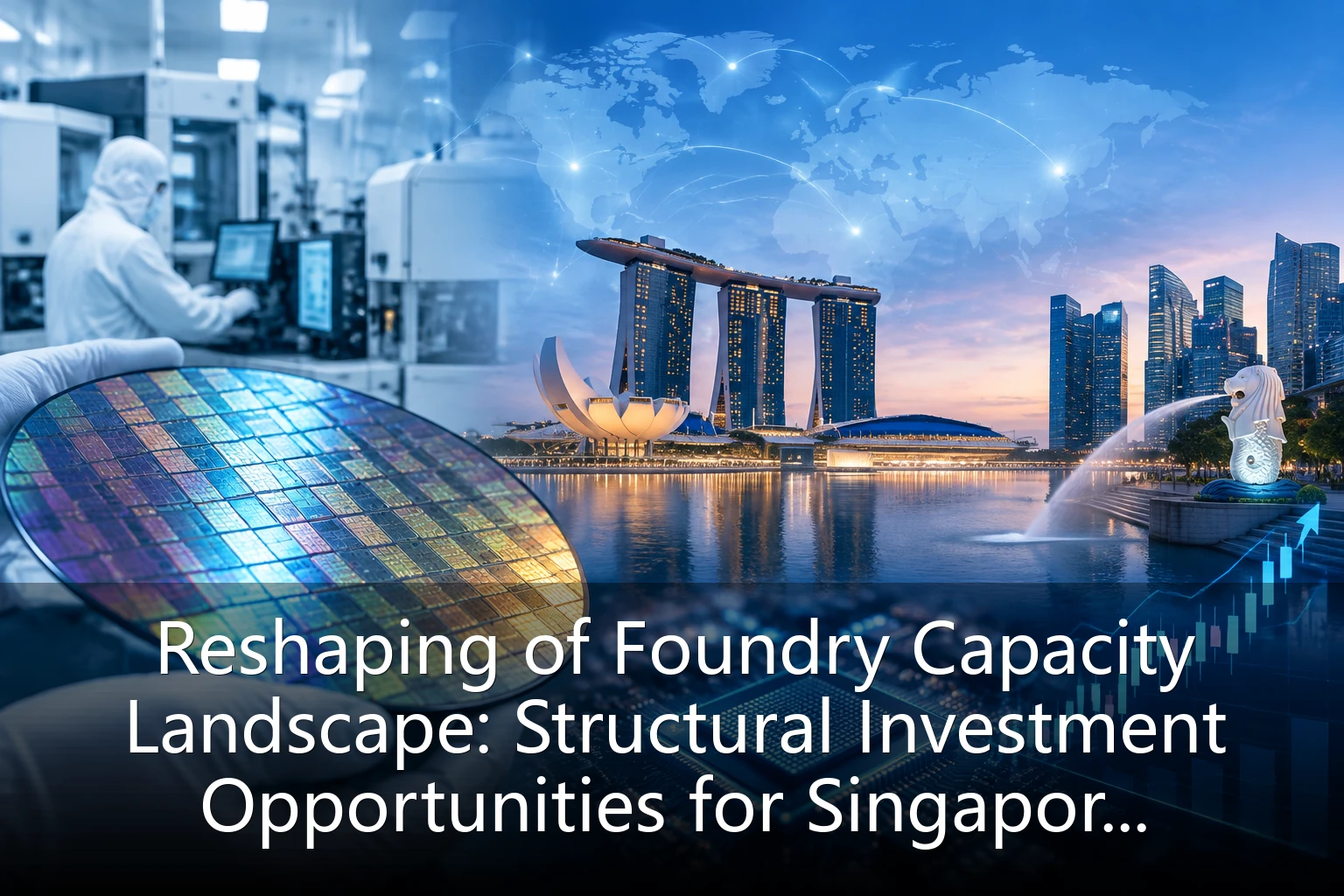
Reshaping of Foundry Capacity Landscape: Structural Investment Opportunities for Singapore Blue-Chip Stocks
Under the wave of rapid AI technology development, the global semiconductor industry is undergoing profound changes. As a core link in the semiconductor industry chain, changes in foundry capacity not only affect the supply structure of the entire industry but also reshape the global semiconductor landscape. As an important semiconductor manufacturing center in Asia, Singapore's expansion and adjustment of foundry capacity are bringing unprecedented investment opportunities to local blue-chip stocks.
New Global Foundry Capacity Landscape
According to the latest industry data, global foundry capacity utilization has climbed to nearly 90% in 2026, reaching a high in nearly two years. This trend is mainly driven by the rapid development of emerging applications such as artificial intelligence, 5G communications, and the Internet of Things, which has led to strong demand for advanced process chips. Especially driven by AI computing power demand, capacity for 7nm and more advanced processes continues to be tight, with a clear imbalance between supply and demand.
At the same time, the global semiconductor supply chain is undergoing structural reorganization. Geopolitical factors, intensifying technological competition, and countries' emphasis on semiconductor self-reliance have prompted nations to accelerate the construction of domestic semiconductor industry chains. Against this background, Singapore, with its stable political environment, complete infrastructure, and internationally aligned business regulations, has become an important choice for global semiconductor manufacturers to expand in Asia.
Singapore's Foundry Capacity Expansion Strategy
In recent years, the Singapore government has continued to increase its support for the semiconductor industry through policy guidance, capital investment, and talent development to promote the upgrading of the local semiconductor industry chain. Data shows that Singapore plans to invest more than 10 billion Singapore dollars in the next five years to strengthen the semiconductor ecosystem, with foundry capacity expansion being a key investment direction.
Under this strategic guidance, both local and international semiconductor companies have increased their capacity deployment in Singapore. TSMC announced plans to increase its Singapore capacity utilization to 95% and invest $3 billion to build a new 12-inch fab; Intel announced a $5 billion investment in Singapore for advanced packaging technology development and capacity expansion; Singapore's local semiconductor equipment manufacturers such as ASMPT are also actively expanding production to meet growing market demand.
AI-Driven New Demand for Foundry Services
The explosive development of artificial intelligence technology is reshaping the demand structure for foundry services. Compared with traditional chips, AI chips place higher requirements on foundries, including more advanced process technologies, larger wafer sizes, and higher yield standards. This change not only drives capacity demand for 7nm, 5nm, and even more advanced processes but also promotes rapid growth in specialized fields such as silicon photonics and RF chips.
Singapore semiconductor companies are actively responding to this challenge. Through cooperation with international leading technologies, independent R&D innovation, and talent development, Singapore has established a competitive advantage in AI chip manufacturing. Especially in advanced packaging and system integration, Singaporean companies have formed unique technical advantages, becoming an indispensable part of the global AI chip supply chain.
Investment Value of Singapore Semiconductor Blue-Chip Stocks
With the expansion of foundry capacity and growth in AI demand, Singapore semiconductor blue-chip stocks are undergoing value reassessment. From a financial performance perspective, in the first half of 2026, revenue of major Singapore semiconductor companies generally achieved double-digit growth, with net profit margins maintained above 20%, showing strong profitability.
Specifically, TSMC's Singapore business segment achieved 18% year-on-year revenue growth and 22% net profit growth in the first half of 2026, with capacity utilization maintained at a high of 95%; Intel's Singapore business achieved 15% year-on-year revenue growth and 19% net profit growth; local semiconductor equipment manufacturer ASMPT achieved 25% year-on-year revenue growth and 30% net profit growth, showing strong growth momentum.
From a valuation perspective, although Singapore semiconductor blue-chip stocks have risen to some extent this year, their valuation remains at a reasonable level compared to other major semiconductor manufacturing centers globally. Especially against the backdrop of continuous explosion in AI computing power demand, the long-term growth prospects of Singapore semiconductor companies remain broad.
Investment Strategy and Risk Analysis
For investors, seizing the investment opportunities brought by foundry capacity expansion requires a diversified investment strategy. On one hand, one can focus on foundry companies that directly benefit from capacity expansion, such as TSMC and Intel's business segments in Singapore; on the other hand, one can also invest in upstream industry chain companies such as semiconductor equipment and materials, such as ASMPT and Sino Kinetic, which will indirectly benefit from equipment replacement demand brought by capacity expansion.
However, investing in semiconductor blue-chip stocks also faces certain risks. First, the global semiconductor industry has obvious cyclical characteristics, and the current high capacity utilization may be difficult to sustain. Once demand slows, the risk of overcapacity will emerge. Second, technological iteration is fast, and companies need to continuously invest in R&D to maintain competitiveness, which challenges their profitability. In addition, external factors such as geopolitical factors and trade friction may also have a significant impact on the semiconductor industry.
Future Outlook
Looking ahead, with the continuous development of emerging applications such as artificial intelligence, 5G, and the Internet of Things, global semiconductor demand will maintain steady growth. With its superior geographical location, complete infrastructure, and strong government support for the semiconductor industry, Singapore is expected to maintain a competitive advantage in the foundry field and become an important node in the global semiconductor supply chain.
For investors, the expansion of foundry capacity not only brings short-term investment opportunities but also reveals the structural trends of long-term development in the semiconductor industry. In this context, Singapore semiconductor blue-chip stocks are expected to undergo value reassessment, providing investors with continuous and stable returns.
Overall, the reshaping of the foundry capacity landscape has brought unprecedented investment opportunities for Singapore semiconductor blue-chip stocks. Investors should closely follow industry dynamics, grasp technological development trends, and actively participate in the investment feast brought by this round of semiconductor industry upgrading under the premise of controllable risks.