
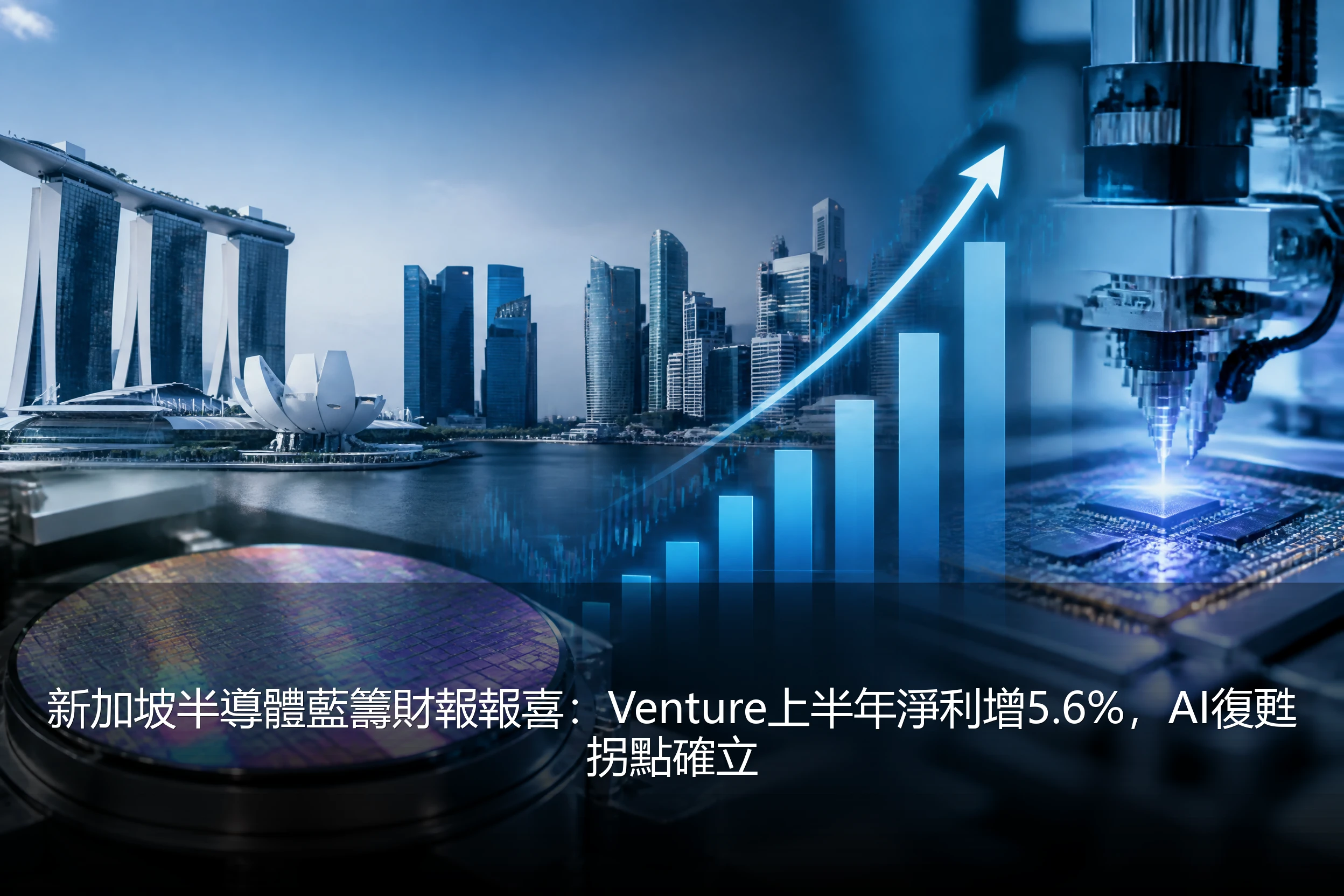
Venture Corporation, a Singaporean semiconductor blue-chip startup (Stock Code: V03), announced its first-half results for 2026 after market close on August 5th, showing a clear operational recovery. The group's net profit for the first half increased by 5.6% year-on-year to S$119 million, with earnings per share reaching 41.4 cents. The second-quarter net profit accelerated by 10.3% year-on-year to S$63 million, with earnings per share at 21.8 cents, indicating warming growth engines quarter over quarter. This financial report is not only a milestone in the company's operational turnaround but is also viewed by the market as a significant signal of the Singapore semiconductor sector exiting a cyclical trough.
End of Three Years of Negative Growth, Full Recovery Signals Emerge
Looking back over the past three years, the company faced continuous pressure on revenue and profitability amid a challenging global environment characterized by inventory adjustments in the electronics industry and weak end-consumer demand, leading to long-term stock price consolidation. However, a turning point began in the first quarter of 2026—quarterly revenue rose by 1.9% year-on-year to S$628.5 million, with a real increase of 8.2% when excluding exchange rate effects, marking the first time in three years that the group achieved positive year-on-year growth. The net profit growth rate further expanded into double digits in the second quarter, demonstrating that the recovery is not a fleeting phenomenon but is supported by real order demand.
In terms of drivers, AI-related infrastructure investment is the core engine of this recovery. The group's business portfolio, which focuses on testing and measurement instruments, networking equipment, and advanced industrial and semiconductor equipment, saw revenue grow by 11.2% year-on-year in the first half to S$417 million, effectively offsetting the sluggish performance of the life science and consumer product segments. The group has both direct and indirect exposure within the AI data center supply chain: the direct part comes from data center electronic components such as server network cards, while the indirect part covers stages like testing instruments, GPU infrastructure, and wafer fabrication equipment.
Semiconductor Business Reach Expands, Opening Long-Term Growth Potential
Notably, the company's semiconductor business landscape is gradually extending from mere wafer fabrication equipment to broader semiconductor system areas such as controllers and sensors. Although the current revenue proportion from these areas is relatively limited, the steady ramp-up of early semiconductor projects, coupled with the increasing demand for high-value-added electronic manufacturing services from AI infrastructure, positions the company to enjoy a longer growth runway in the coming years.
Management's outlook for the second half of 2026 is also relatively optimistic: the consumer electronics product line is expected to gradually recover due to New Product Introduction (NPI), and while the life science business remained flat in the short term, the product development pipeline is robust, promising medium-to-long-term growth. Overall, the group anticipates stronger momentum in the second half compared to the first half, significantly increasing the probability of returning to a growth trajectory for the full year.
Dividend Increase of 20%, Shareholder Returns Significantly Upgraded
In addition to improved profitability, the company has demonstrated commitment to shareholder returns. The board recommended an interim dividend of 30 cents per share, a 20% increase from the 25 cents paid in the corresponding period last year. The dividend will be paid on September 11th, with the record date for stock registration being September 1st. Based on the current stock price, the implied dividend yield is approximately 4.9%, which is quite attractive among Singaporean blue-chip stocks.
What reassures investors is the group's financial structure: as of the end of March, the company holds over S$1 billion in net cash and has zero debt, with net cash accounting for about 28% of the total market capitalization. With prudent capital expenditure and stable cash flow, the company has the capability to continuously increase the dividend payout ratio and conduct share buybacks, providing a solid downside protection for the stock price.
Industry Tailwind Strong: Record Equipment Spending and Expanding Singapore Ecosystem
Looking at the overall industry environment, the startup's impressive financial report coincides with the global semiconductor upcycle. The latest forecast from the Semiconductor Industry Association (SEMI) indicates that global semiconductor manufacturing equipment sales are expected to hit a record high of $165.9 billion in 2026, growing by 23.2% year-on-year, with growth momentum continuing through 2028, reaching $229.5 billion. Concurrently, the global semiconductor market size is expected to exceed $1 trillion this year, driven primarily by the strong demand for AI chips and memory.
Singapore, as a vital node in the global semiconductor supply chain, also benefits from this expansion wave. Micron announced a $24 billion investment over the next decade to build advanced wafer fabs in Singapore, and United Ocean Technology has increased its capital expenditure this year to $2 billion to expand the silicon photonics capacity at its P4 plant in Singapore. TSMC's 12-inch fab in VSMC Singapore has also entered mass production. The upstream and downstream industries are expanding in tandem, providing fertile ground for blue-chip stocks related to semiconductors in Singapore.
Institutional Views Turn Optimistic; Long-Term Investment Strategy is Recommended
Following the earnings release, research institutions have significantly improved their outlook on the startup. DBS Group Research upgraded its rating to "Buy," raising the target price from S$17.90 to S$21.80, corresponding to an estimated Price-to-Earnings ratio of about 24 times, and forecasting earnings growth of 9% and 6% for 2026 and 2027, respectively. The bank believes that after three years of adjustment, the company's worst period is over, and AI infrastructure demand will serve as a continuous growth catalyst.
For investors, the startup's case provides several key insights: First, Singaporean semiconductor blue chips are not limited to playing cyclical stock roles; their earnings visibility is clearly improving amid structural growth in AI demand. Second, companies with net cash, stable dividends, and technological niches often possess greater valuation recovery resilience during a cyclical rebound. Third, in terms of investment, attention should be paid to risk factors such as order visibility, new product introduction progress, and exchange rate fluctuations, and investors should avoid excessively chasing short-term gains.
Overall, the startup's first-half financial report marks the establishment of a recovery inflection point for Singaporean semiconductor blue chips. With the multiple supports of continuous expansion in global AI capital expenditure, record demand for semiconductor equipment, and the accelerating growth of the local ecosystem in Singapore, the investment value of the Singaporean semiconductor sector is regaining market attention. Investors are advised to closely monitor subsequent quarterly order momentum and product portfolio changes to seize the opportunities in this industry upcycle.