 <\/div><\/div>
Japan and South Korea Stock Markets: A Tale of Two Extremes: Structural Rivalry Behind Tech Giant Rally<\/h1>\nKeywords<\/h2>\n
Japan-Korea stock markets, Samsung Electronics, SK Hynix, Bank of Japan rate hike, American Depositary Receipts, Morgan Stanley<\/p>\n
\n
Introduction<\/h2>\n
On June 24, Japan and South Korea stock markets showed sharply divergent trends in early trading: the Korea Composite Stock Price Index surged over 4% on strong tech stocks, while Japan's Nikkei 225 fluctuated amid monetary policy uncertainty. This stark contrast not only reflects short-term sentiment divergence but also reveals the deep impact of corporate governance reform and macro policy paths on market confidence. This article analyzes the internal logic of the market volatility from three dimensions: the buyback action of South Korea's tech giant, the ADR listing process, and the internal rate hike calls within the Bank of Japan.<\/p>\n
\n
1. Samsung Electronics 'Stock-for-Bonuses': Labor-Management Compromise Behind the Buyback Plan<\/h2>\n
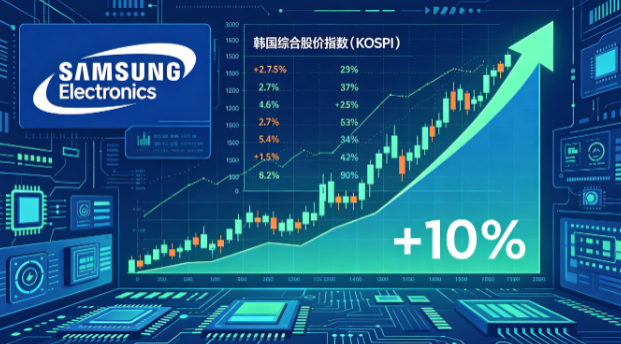
The Korea Composite Stock Price Index rose over 4% in early trading to 8,525.8 points, with Samsung Electronics shares surging nearly 10%, leading the rally. The direct catalyst was market speculation that Samsung might announce a massive 90 trillion won share buyback to fund employee performance bonuses. Reportedly, the buyback plan stems from an agreement between Samsung management and the union—the company will use stock instead of cash for bonuses, thereby avoiding cash outflow and incentivizing long-term holding.<\/p>\n
However, shareholder reaction is not entirely positive. While large-scale buybacks can boost stock prices in the short term, without earnings growth support they may dilute earnings per share or squeeze R&D spending. This reflects the difficult balance South Korean chaebol must strike between labor relations and capital returns. Samsung may announce details soon, and the market is closely watching the pace and final execution ratio of the buyback.<\/p>\n
\n
2. SK Hynix's 'Dual Listing' Chess: A Springboard from Home to Nasdaq<\/h2>\n
Another focus is SK Hynix shares briefly jumping 5%. According to reports, the company plans to submit a securities registration statement related to American Depositary Receipts (ADR) listing to the Financial Supervisory Service (FSS) on Wednesday. Under regulations, a company must first issue shares domestically in South Korea before listing ADRs on the Nasdaq. The market estimates that the FSS could complete document review by July 3, meaning SK Hynix's ADR listing could be finalized in July.<\/p>\n
This move not only opens the door to international capital markets for SK Hynix but also provides a financing template of 'domestic first, overseas later' for other South Korean tech firms. Given SK Hynix's leading position in the global memory chip sector, its ADR listing is expected to attract significant institutional funds from the U.S. and Europe, further strengthening the international pricing power of South Korea's semiconductor industry. Notably, the Korea Composite Stock Price Index plunged 10% on Tuesday; Morgan Stanley analysts characterized it as 'a breather, not a breakdown,' suggesting the pullback was a technical correction rather than a trend reversal.<\/p>\n
\n
3. Bank of Japan's 'Rate Hike Calls': How Far Is Policy Rate from Neutral?<\/h2>\n
In contrast to South Korea's strong rebound, Japan's Nikkei 225 fluctuated, closing at 69,797.88 points. The summary of opinions from the Bank of Japan's June policy meeting released on Wednesday showed that some board members strongly urged further rate hikes to push the policy rate closer to the 'neutral rate' level. One board member explicitly stated: 'Unlike the United States and Europe, Japan's policy rate remains below the estimated range of the neutral rate, and it is necessary to move the policy rate toward the neutral level as soon as possible.'<\/p>\n
This stance highlights the policy divide within the BOJ: on one hand, ultra-loose monetary policy continues to compress bank interest margins; on the other hand, inflation pressure and the yen's depreciation are eroding profits of import-dependent companies. If the central bank tightens prematurely, it could hurt the nascent economic recovery; if it stays put, there is a risk of asset bubbles. This policy dilemma has significantly increased short-term volatility in Japanese stocks.<\/p>\n
\n
Conclusion<\/h2>\n
Looking at the two markets, South Korea's stock market is driven by corporate-level incentive mechanisms and international financing, showing a recovery driven by 'micro-structure improvement'; Japan's stock market is more influenced by macro policy expectations, in a waiting period before 'rate normalization.' In the short term, momentum for South Korean tech stocks may continue, but one must be wary of profit-taking after the buyback plan is implemented. For Japan, investors should closely watch the final decision at the BOJ's July meeting; if a rate hike signal is confirmed, Japanese stocks may face valuation pressure. As the turning point of global liquidity conditions remains unclear, structural divergence among markets will be a main theme for Asia-Pacific stocks in the second half of the year.<\/p>

Zhipu AI Market Cap Hits Trillion; GLM-5.2 Ignites Market
NextMulti-field Market Breakthroughs: Investment Opportunities in Energy, Technology & Transport
Related Articles