 <\/div><\/div>
International Gold Price Plunge, Hong Kong Gold Stocks Rout: Deep Logic and Outlook<\/h1>
Keywords: Gold Price, HK Gold Stocks, Fed Rate Hike, USD Strength, Fund Rotation, Stop-Loss Selling<\/h2>
Introduction<\/h2>
Introduction<\/h2>
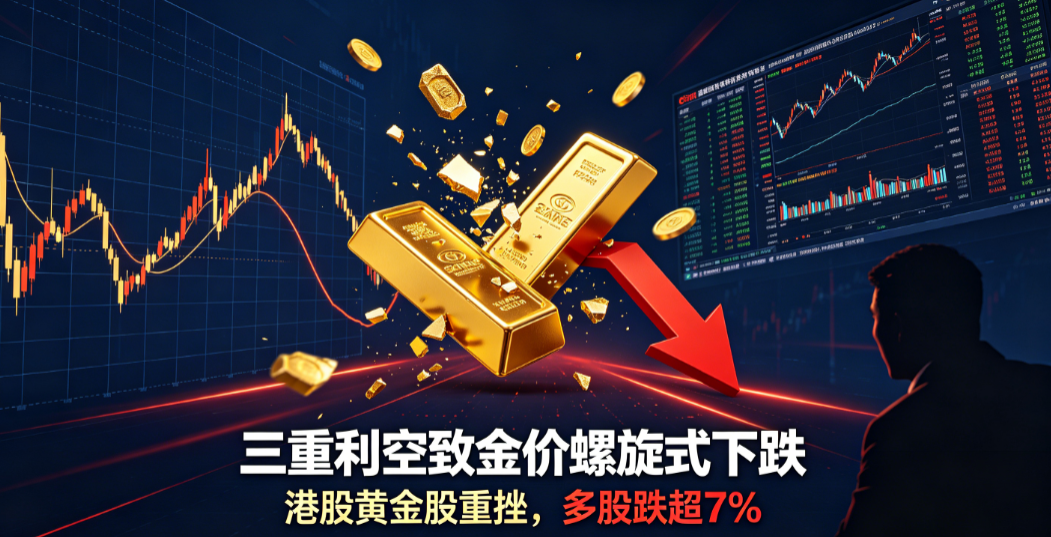
Recently, international financial markets saw another upheaval. As international gold prices hit new lows consecutively, Hong Kong gold stocks collapsed, with Zhaojin Mining, China Gold International, and Lingbao Gold all falling over 7%, prompting investors to reassess gold's value as a traditional safe haven. At press time, London spot gold fell below $4,000\/oz, down nearly 30% from the historic high of $5,600 early this year, with bearish sentiment fully erupted. This gold price decline is not an isolated event but a confluence of multiple macro factors and micro trading structures. This article delves into the causes of the gold adjustment from macro background, institutional views shift, fund flow patterns, and technical stop-loss chain reactions, and explores possible future paths based on the latest market dynamics.<\/p>
1. Macro Environment Turmoil: Rate Hike Expectations Reshape Interest Rate Framework<\/h2>
As a non-yielding asset, gold's price is highly sensitive to real interest rates and dollar liquidity. The primary driver of this gold crash is the sudden surge in market expectations of Fed rate hikes. Reference content indicates that if inflation remains high, the Fed could raise rates as early as September. This expectation stems from the "double hot" performance of recent US employment and inflation data. Although markets initially hoped for a rate cut cycle, the latest data show core PCE still above target, and non-farm payrolls exceeded expectations for months. This has revived hawkish voices within the Fed, leading to sharp repricing of the policy rate path.<\/p>
Driven by rate hike expectations, the dollar index hit a year-to-date high, directly pressuring dollar-denominated gold. Historical patterns show a significant negative correlation between dollar liquidity and gold prices: when the dollar strengthens and liquidity tightens, gold's appeal as an alternative currency diminishes, with funds flowing back to dollar assets. Moreover, rising real rates increase the opportunity cost of holding gold. Investors prefer bonds and deposits offering positive returns over zero-yield gold. This logic is being repeatedly validated in the current environment.<\/p>
2. Wall Street Banks Slash Price Targets: The Lethal Power of Expectation Management<\/h2>
Beyond the direct impact of macro data, systemic downward revisions by institutions have exacerbated gold futures' decline. In reference content, Deutsche Bank cut its Q4 gold forecast by 17% to $4,800\/oz, and Goldman Sachs lowered its 2026 year-end target by $500 to $4,900\/oz. Notably, these cuts are not isolated but a collective shift in "expectation consensus." Several Wall Street banks adjusting forecasts in a short period often create a compounding effect on market sentiment, prompting traders to cut positions early.<\/p>
Behind these target cuts lie concerns about changes in gold demand structure. On one hand, central bank gold purchases have slowed. From 2024 to early 2025, central banks worldwide significantly increased gold holdings, boosting prices. But now, as some emerging markets stabilize their reserve structures, central bank buying has notably decelerated. On the other hand, ETF gold holdings continue to decline, indicating long-term allocation funds are withdrawing. Data show holdings of the world's largest gold ETF, SPDR Gold Trust, have fallen about 15% from the year's high, showing waning institutional investor appetite for gold.<\/p>
3. Fund Rotation Intensifies: AI Narrative Siphons Safe-Haven Funds<\/h2>
Analysis from Guosen Securities provides another perspective: besides employment and inflation reshaping rate expectations, the AI narrative gaining clarity has driven funds from gold to tech assets. This is confirmed by the May Bank of America Global Fund Manager Survey. The survey shows the crowdedness of long gold dropped from the top in 2025 to fourth place, with only 1% of respondents, while long global semiconductors ranked first with 73%. This data vividly illustrates the risk appetite shift in current market funds.<\/p>
As a safe-haven asset, gold's appeal usually rises with high economic uncertainty. However, the current global economy is not in a typical "crisis mode" but a transition period accelerated by technological revolution. Breakthroughs in AI and semiconductors have sharply raised investors' expectations of tech stocks' future earnings. In an improving risk appetite environment, funds flowing from defensive assets like gold to high-growth tracks is a rational asset allocation adjustment. This trend is especially clear in US stocks: the Nasdaq index continues to rise led by tech giants, while gold futures keep falling, forming a stark contrast.<\/p>
4. Crowded Longs Trigger Stop-Loss Cascade: Spiral Decline<\/h2>
Technical factors also played a key role in this decline. Reference content notes that when gold prices peaked early this year, massive crowded long positions accumulated. As gold broke through key support levels of $4,500, $4,300, and $4,200 in a short period, stop-loss orders surged, creating a spiral decline. This process resembles a "longs killing longs" stampede: trend-following funds trigger automated selling, further depressing prices and triggering more stop-loss orders. This negative feedback loop is especially violent when liquidity is low.<\/p>
From position data, COMEX gold futures non-commercial net long positions have shrunk significantly over the past weeks, reflecting speculative funds systematically reducing gold bets. Meanwhile, implied volatility in options surged, indicating heightened market expectations of large price swings. These technical signals, combined with fundamental factors, have amplified short-term downside risk.<\/p>
5. Hong Kong Gold Stocks Under Pressure: Fundamental and Sentiment Double Hit<\/h2>
The rout in Hong Kong gold stocks is a direct reflection of the international gold price crash. Stocks like Zhaojin Mining, China Gold International, and Lingbao Gold fell over 7%, reflecting market concerns about gold companies' earnings outlook. Gold stock prices are usually highly correlated with gold prices: lower gold prices directly compress miners' profit margins, especially against rising mining costs. Additionally, the fragile sentiment in the Hong Kong market, combined with liquidity pressure from Fed rate hike expectations, makes gold stocks a concentrated target for shorts.<\/p>
Notably, the gold stock rout also implies a market repricing of the sector's long-term prospects. Some institutions question whether the high gold price before 2025 was merely a "flash in the pan" bubble. If gold prices linger below $4,000, small-scale, high-cost mines may fall into losses, possibly triggering industry consolidation. This expectation further depresses sector valuations.<\/p>
6. Outlook: Darkness Before Dawn or Deeper Correction?<\/h2>
Combining the above analysis, the current gold market is in a period of concentrated bearish factors. In the short term, Fed rate hike expectations and USD strength remain the main headwinds. Without new catalysts, gold prices may continue to find support at lower levels. But in the medium to long term, gold's fundamentals are not entirely pessimistic. Geopolitical risks, high global debt, and de-dollarization trends still provide potential safe-haven demand for gold. Some analysts suggest that if the US economy falls into recession during the rate hike cycle, forcing the Fed to restart easing, gold could see a rebound window.<\/p>
For investors, a more cautious strategy is advised at this stage. On one hand, be wary of downside risks from continued trend-following fund outflows. On the other hand, monitor whether gold can stabilize at key support levels (e.g., $3,500-$3,800). Once stabilization signals appear, it may be an opportunity to gradually accumulate gold assets. For Hong Kong gold stocks, valuations are at historical lows, but a reversal still requires confirmation of a trend recovery in gold prices.<\/p>
Conclusion<\/h2>
This round of international gold price plunge and Hong Kong gold stocks rout is the result of multiple factors: macro rate hike expectations, institutional expectation adjustments, fund rotation, and technical long liquidation. It is not just a gold market fluctuation but a microcosm of profound changes in global asset allocation—the AI revolution is siphoning safe-haven funds at an unprecedented pace, while gold suffers from the dual pressure of rising rates and a strong dollar. In the short term, gold prices face further adjustment risks, but medium-term performance still depends on Fed policy direction and global economic fundamentals. Investors should maintain caution and flexibly adjust positions based on a clear understanding of current market mechanisms to cope with possible further volatility.<\/p>

Related Articles