
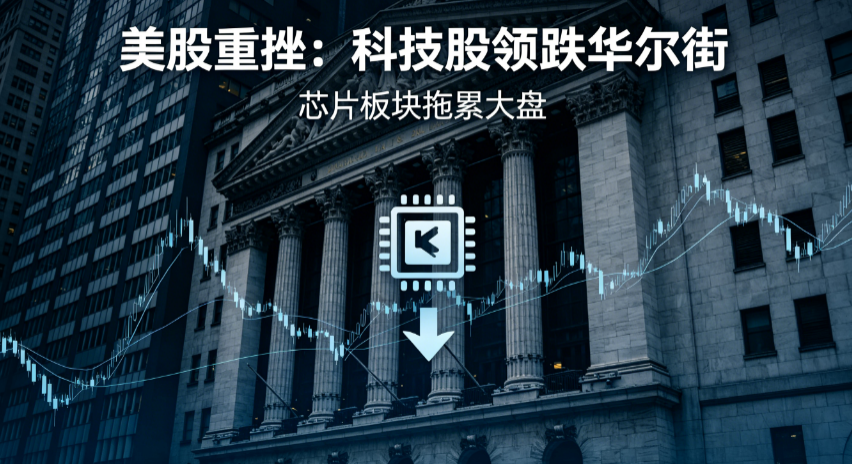
June 11, Caixin News - On Wednesday (June 10), risk aversion quickly heated up in global capital markets. The three major US stock indices fell throughout the day, closing near session lows. The Dow and Nasdaq fell nearly 2%, while the S&P 500 and Nasdaq both hit new multi-week lows. Market sentiment was broadly bearish.
As of the latest closing data, the Dow Jones Industrial Average fell 1.87% to 49,918.78 points; the S&P 500 fell 1.62% to 7,266.99 points; the Nasdaq Composite Index plunged 1.98% to 25,169.50 points. Tech and growth heavyweights collectively weakened, becoming the core drag on the broader market.
The sharp decline in US stocks was mainly driven by the double headwinds of Middle East geopolitical risks and higher-than-expected US inflation data. On the news front, US President Trump publicly stated that Iran missed a favorable opportunity for an agreement and must pay a corresponding price. Subsequently, the US clearly signaled a tough stance, with the White House and Defense Secretary Hegseth successively confirming that the US military would launch a fierce strike and bomb key facilities in Iran on the evening of the 10th. The Middle East tensions escalated sharply, directly boosting global risk aversion, leading to widespread selling of risk assets.
Institutional views pointed out that the escalating Middle East conflict completely disrupted the market's previous optimistic expectations. Jed Ellerbroek, portfolio manager at Argent Capital Management, analyzed that the market had widely anticipated a US-Iran deal and the restoration of stable shipping through the Strait of Hormuz. If the conflict continues to escalate, international oil prices will surge significantly, global inflation pressures will rise again, and investment environment uncertainty will increase substantially.
At the same time, the newly released US May CPI data further exacerbated market panic, completely reversing Fed policy expectations. The data showed that the US May CPI surged 4.2% year-over-year, the highest since May 2023, and core CPI rose 2.9% YoY. Combined with the previously stronger-than-expected non-farm payroll data, market expectations for rate cuts have fully faded, and the probability of a Fed rate hike within the year has risen sharply. The CME FedWatch Tool shows that the current probability of a rate hike this year is close to 70%.
The tightening rate expectations directly hit high-valuation tech stocks, and the US chip sector saw another sell-off. On that day, major semiconductor ETFs fell sharply: the VanEck Semiconductor ETF (SMH) closed down 3.4%, and the iShares Semiconductor ETF (SOXX) plunged 3.67%. The sector came under pressure again after a brief rebound on Monday, with capital continuously flowing out of high-valuation tech and semiconductor sectors, becoming the core driver of the Nasdaq's decline.
Overall, the US stock market is currently facing three major headwinds: geopolitical conflict disruptions, high inflation, and expectations of monetary policy tightening. Short-term market volatility will continue to expand, and the chip and tech growth sectors will still face significant adjustment pressure.