 <\/div><\/div>
Title: Japanese and Korean Stock Markets Surge: Semiconductor Giants Lead Gains, Global Tech Stocks Welcome New Momentum<\/h3>
Keywords: Nikkei 225, KOSPI, Semiconductor, SK Hynix, Micron Technology, AI Memory, Circuit Breaker<\/h3>
Introduction<\/h3>
Introduction<\/h3>
In the vast canvas of global capital markets, every subtle shift can affect investors' nerves. On June 25, the opening performance of Asian markets undoubtedly injected a strong stimulant. Both major indices of Japan and South Korea surged on gap openings; the KOSPI's rise was particularly significant, triggering the KOSPI market's circuit breaker mechanism at one point. The core driving force of this rally stems from major positive news in the global semiconductor industry, especially in the memory chip sector. This article will deeply analyze the specific market performance that day, explore the underlying factors, and combine with US stock market movements to present readers with a panorama of new momentum in global tech stocks.<\/p>
1. Asian Open: Japanese and Korean Markets Rise Together, Market Sentiment High<\/h3>
On June 25, Japanese and Korean stock markets kicked off the new trading week with a strong posture. According to real-time data, as of 8:06 Beijing time, Japan's Nikkei 225 surged 2.32%, while the KOSPI showed a more astonishing gain of 5.51%. This data not only reflects the Asia-Pacific region's immediate reaction to global tech dynamics but also indicates strong confidence among regional investors for the coming months, especially in the AI-driven tech theme.<\/p>
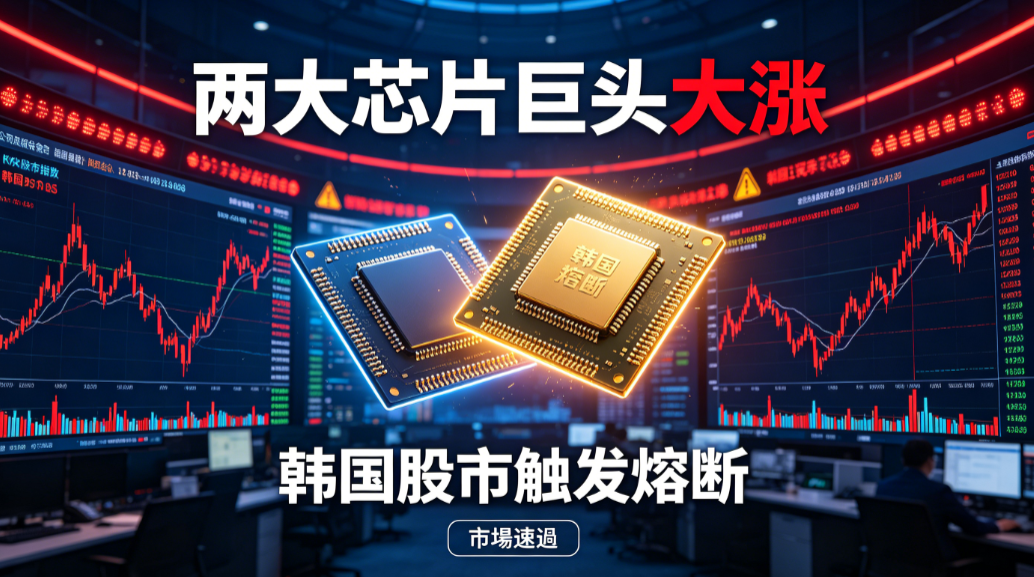
Notably, shortly after opening, the South Korean market triggered technical control measures. As KOSPI200 index futures surged 5% in a short period, the Korea Exchange activated the KOSPI market's circuit breaker mechanism according to regulations, suspending all program trading for 5 minutes. This mechanism aims to give traders time to calm down during extreme volatility and prevent irrational behavior from amplifying market fluctuations. The triggering of the circuit breaker indirectly confirmed the overwhelming buying power and extreme market exuberance that day.<\/p>
Analysts pointed out that the joint rise of Japanese and South Korean stock markets is not an isolated event. As key links in the global semiconductor supply chain, the economic performance of Japan and South Korea is closely tied to the rise and fall of the semiconductor industry. When the global memory chip market receives major positive news, the two countries' stock markets often react most sensitively and strongly. This rally can be seen as the market's positive pricing of the recovery in upstream industry chain sentiment.<\/p>
2. Core Driver: South Korean Chip Giants' Rally and Capital Deployment<\/h3>
In the collective rise of South Korean stocks, two chip giants stood out. Data shows that as of press time, SK Hynix shares surged 11%, while Samsung Electronics rose over 5%. These two companies account for a significant weight in the South Korean stock market, and their strong performance directly propelled the KOSPI's substantial increase.<\/p>
The direct catalyst for this stock price surge came from a major capital operation plan by SK Hynix. On June 24, SK Hynix submitted a statutory announcement to the Korea Financial Supervisory Service's electronic disclosure system, announcing plans to issue American Depositary Receipts (ADRs). The fundraising scale is as high as 45.45 trillion South Korean won, equivalent to about 29.43 billion US dollars, and is expected to be formally traded on the Nasdaq exchange in the US on July 10. This massive fundraising plan is extremely rare in global capital markets, fully demonstrating SK Hynix's ambition for future development and international investors' expectations for its business prospects.<\/p>
SK Hynix clearly stated in the announcement the purpose of this huge fund: to broaden its global investor base, increase investment in AI memory (HBM) capacity, build the Yongin wafer fab, and the Cheongju advanced packaging production line. It is clear that the company's future strategic focus is entirely on the AI field. HBM (High Bandwidth Memory) is a core component for AI servers and high-end computing cards. As the global AI large model race heats up, demand for HBM is growing exponentially. SK Hynix's move is not only to meet existing customer demand but also to occupy an absolute capacity high ground in the upcoming AI memory explosion. This action sends a strong signal to the market: the hardware infrastructure buildout for the AI industry is accelerating, and the cyclical boom in upstream memory chips is far from over.<\/p>
3. US Market Link: Earnings Beat Leads to After-Hours Surge<\/h3>
The waves in the global semiconductor market not only echoed in Asian stocks but also traced back to the overnight US market. During the US trading session on June 24, the three major indices were mixed, chip stocks showed divergence, with the Philadelphia Semiconductor Index edging down 0.18%, and shares of companies like Qualcomm and Rambus falling to varying degrees. However, the real highlight came after hours.<\/p>
Memory chip giant Micron Technology reported its third fiscal quarter earnings for the quarter ending May 31 (context: likely fiscal 2024). This earnings report far exceeded market expectations, triggering violent after-hours price fluctuations, surging over 16% at one point. The report showed that Micron's quarterly revenue surged approximately 346% year-over-year to $41.46 billion. On a non-GAAP basis, adjusted earnings per share (EPS) increased over 12 times year-over-year to $25.11. More optimistically, Micron gave an encouraging outlook for the next quarter, forecasting adjusted revenue of $49 billion to $51 billion for the fourth fiscal quarter, well above analysts' consensus estimate of $43.24 billion.<\/p>
Micron, along with SK Hynix and Samsung Electronics, are the three global memory chip giants. Micron's stellar earnings and strong guidance confirmed from the sidelines that the entire memory chip industry, especially AI-related high-end products (like the equivalent of HBM in Micron's product line), has entered a high-growth phase. This good news from a competitor greatly boosted investor confidence in the entire industry, directly driving the sharp surge in SK Hynix and Samsung Electronics shares in Asian markets the next day.<\/p>
4. Structural Differences: Market Divergence in AI Dividends<\/h3>
Although the overall market showed a broad rally, the structural characteristics of capital flows are very clear when examined closely. In the US market, not all chip stocks benefited from this round of gains. For example, companies like Qualcomm and Skyworks Solutions, which focus on communication RF chips, were not boosted and saw their share prices fall instead. This divergence highlights that the core driving force of the current market is "AI memory" rather than "general-purpose chips."<\/p>
This divergence is also reflected in investment logic. The traditional chip cycle is subject to demand fluctuations in consumer electronics like smartphones and PCs. In contrast, the current AI chip cycle is driven by capital expenditure from large data centers and cloud service providers. The rigidity and sustainability of this demand far exceed the consumer-level market. Therefore, whoever dominates the AI memory (especially HBM) segment will command the highest valuation premium. SK Hynix is undoubtedly a pioneer in this regard, while Samsung Electronics is also catching up. Micron's earnings proved that the entire sector is benefitting.<\/p>
For investors, identifying this structural divergence is crucial. A simple "buy chip stocks" strategy may be outdated, replaced by the need to precisely identify companies at the core of the AI supply chain. When SK Hynix announced its ADR issuance and massive capacity expansion, it was effectively sending an invitation to global investors: the hardware era of artificial intelligence has arrived, and the opportunity to get on board is right now.<\/p>
5. Outlook and Prospects: Global Resonance of the AI Investment Theme<\/h3>
From the opening gains in Japanese and South Korean stocks, to Micron's earnings surprise, to SK Hynix's massive financing, this series of events outlines the clearest investment theme in current global capital markets: artificial intelligence. It is no longer just a concept or a hot topic but has tangibly translated into corporate earnings growth, capacity expansion, and real capital operations.<\/p>
Looking ahead, this AI-driven semiconductor super-cycle is likely to have stronger resilience. First, on the demand side, global tech giants are still increasing investment in AI infrastructure, with no signs of slowing in the short term. Second, on the supply side, the production process for high-end memory chips is complex, and capacity expansion cycles are long, meaning that supply tightness is unlikely to ease fundamentally in the next one to two years, providing stable pricing power for related companies.<\/p>
However, investors also need to remain cautious. Rapid short-term gains may trigger profit-taking pressure, and global macroeconomic uncertainties (such as inflation, geopolitical risks) could also impact high-valuation tech stocks. But overall, taking a long-term view, the productivity transformation brought by AI has only just begun. The enormous demand for computing power, storage, and networking will bring unprecedented development opportunities for the entire semiconductor industry chain.<\/p>
Conclusion<\/h3>
The strong performance of Japanese and South Korean stock markets on June 25 was no coincidence. It is a microcosm of the global semiconductor industry, especially the memory chip sector, entering a new boom cycle driven by the AI wave. South Korean chip giants, boosted by both Micron's better-than-expected earnings and their own strategic capacity expansion, led the market higher, even triggering a circuit breaker. This chain reaction clearly reveals the core driving force of today's capital markets: AI is no longer just a future story; it has become a real force driving corporate earnings and reshaping the industry landscape. For investors, staying close to this historic trend and deeply understanding the structural opportunities in the supply chain may be key to capturing growth with certainty in a complex and changing market.<\/p>

Multi-field Market Breakthroughs: Investment Opportunities in Energy, Technology & Transport
NextTrump Suddenly Withdraws Housing Bill, Political and Rate Fight Escalates
Related Articles