Strategic Reshaping of the Global Semiconductor Industry: From Technological Co-opetition to Economic Dynamics
Keywords
Semiconductor, Supply Chain Restructuring, US Dollar Rate Hikes, Geopolitics, CHIPS Act, Advanced Process, Self-Sufficiency
Introduction
When we talk about the technological cornerstone of the 21st century, semiconductors are undoubtedly the brightest and most fragile piece. From smartphones to AI servers, from EVs to military satellites, chips have become the "digital oil" of modern civilization. However, in the past few years, the global semiconductor industry has experienced extraordinary turbulence: first, a historic shortage triggered by the pandemic, then an inventory correction due to a sudden chill in end demand, coupled with aggressive rate hikes by the US Federal Reserve and escalating geopolitical tensions. The industry's cyclical fluctuations have become intertwined with macroeconomic structures in unprecedented ways. This article starts from the structural changes in the semiconductor industry, combined with recent financial phenomena such as a strong US dollar and weakening gold prices, to explore the deep-seated restructuring of the global chip ecosystem.
I. The "Dual Nature" of Semiconductors: Technology Engine and Macro Barometer
The semiconductor industry has long been seen as a barometer of technological innovation, with its rise and fall often leading the overall economic cycle. But in recent years, the industry logic has undergone a qualitative change: chips are no longer just components for consumer electronics, but national strategic resources, chips in geopolitical games, and even a microcosm of financial market volatility.
As the Fed raised rates continuously to curb inflation, global capital costs rose, and tech stock valuations saw sharp corrections. Semiconductor giants such as Intel, Micron, and Samsung successively announced cuts in capital expenditure, while at the same time, governments around the world competed to pour hundreds of billions of dollars in subsidies for local fabs. This contradictory landscape of "cold market, hot policy" precisely illustrates that semiconductors have escalated from a purely commercial contest to an arena of national security and economic sovereignty.
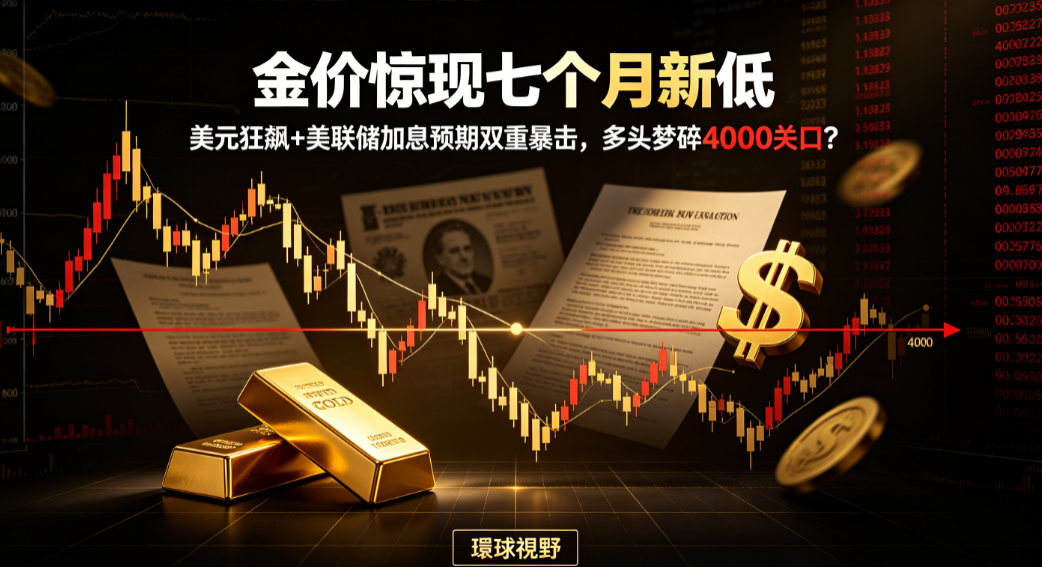
The chart above shows gold prices falling to a seven-month low, while the US dollar remains strong under the Fed's hawkish policies. This typical picture of "strong dollar, weak gold" reflects the reality of global liquidity tightening. For the semiconductor industry, a strong dollar means that equipment, materials, and IP licensing costs denominated in US dollars increase relatively, thereby squeezing margins for non-US fabs; while falling gold prices imply easing risk aversion and rising risk appetite—theoretically beneficial for growth stocks like semiconductors. However, current investor sentiment toward semiconductors is full of contradictions: on one hand, they are optimistic about long-term AI chip demand; on the other hand, they worry about inventory digestion and the risk of decoupling from geopolitical supply chains.
II. Process Competition and the Economic Dilemma of "Moore's Law"
In the advanced process realm, the race between TSMC and Samsung to mass-produce 3nm has entered a white-hot phase. However, as the complexity of chip design and manufacturing increases exponentially, development costs have already soared beyond the sky. A brand-new 5nm fab investment often exceeds $20 billion, forcing most IC design companies to rely on a few foundries. This "winner-takes-all" concentration trend creates a fragile supply chain structure—any unexpected shutdown of an advanced fab could trigger a chain reaction of disruptions across the global electronics industry.
Meanwhile, under US export control pressure, Chinese semiconductor players are forced to accelerate domestic substitution. From EDA tools to photoresist, from etching machines to ion implanters, every piece of the autonomous supply chain puzzle is being closely examined. But the reality is that even under the most optimistic timeline, it is difficult to bridge the process gap with TSMC and Intel within five years. This "chaser's" dilemma has created a kind of "technological Iron Curtain" in the global semiconductor industry.
III. How the Dollar Cycle Affects Semiconductor Investment Logic
The Fed's monetary policy impacts the semiconductor industry through three main channels: First, interest rate levels determine corporate financing costs and the marginal efficiency of R&D investment; second, the strength of the dollar affects global semiconductor trade pricing, especially for commoditized chips like memory; third, rate hikes suppress end-consumer demand, thereby extending the chip inventory adjustment cycle.
Currently, the US dollar index remains elevated. Although it has fallen from its 2022 highs, the Fed has repeatedly hinted at "Higher for Longer," which exerts pressure on the semiconductor recovery timeline. Interestingly, gold prices have fallen to a seven-month low, suggesting the market is digesting expectations of a "soft landing." If inflation cools smoothly and the economy avoids recession, the next upward cycle for semiconductors could start earlier in the second half of 2024; conversely, if high rates trigger systemic risks, chip demand may face a deeper U-shaped recovery.
IV. Supply Chain Migration Under Geopolitical Reshaping
The rollout of the US CHIPS and Science Act and the EU European Chips Act marks a shift in the global semiconductor supply chain from "efficiency first" to "security first." Governments are unanimously requiring foundries to build capacity locally, pushing global semiconductor fixed asset investment to a record high of nearly $200 billion in 2023. However, new capacity is heavily concentrated in the US, Japan, Europe, and Southeast Asia, potentially leading to regional overcapacity coexisting with global supply-demand mismatches.
More noteworthy is the "decoupling" trend in the flow of semiconductor talent. In the past, semiconductor engineers from Taiwan, South Korea, and China frequently moved across borders; now, under tightened national security reviews, technology diffusion channels are blocked. In the long run, this "talent iron curtain" may reshape the industry's competitive landscape more profoundly than trade controls.
V. Investor Response Strategies: Finding Structural Growth Drivers
Against a backdrop of macroeconomic uncertainty, semiconductor investment strategies need to shift from "cycle betting" to "structural selection." Here are several long-term trends worth watching:
- AI and HPC Chips: The explosion of large language models and generative AI has led to a leap in demand for GPUs, ASICs, and HBM memory. Despite short-term inventory adjustments, the long-term momentum is clear.
- Automotive and Industrial Chips: Electrification and intelligence are boosting automotive semiconductor content, with mature nodes above 28nm still in short supply.
- Quantum and Silicon Photonics: As potential alternatives in the post-Moore era, emerging technologies are still nascent but receiving increasing policy support.
- Semiconductor Equipment and Materials: In the wave of supply chain autonomy, equipment and materials vendors are the biggest beneficiaries, and are less directly affected by chip cycle volatility.
Additionally, investors should closely monitor the progress of national subsidy policies and marginal changes in geopolitical risks. Should the US election result bring another trade policy shift, or should Sino-US tensions see a phase of easing, the semiconductor sector could experience a valuation recovery.
Conclusion
The semiconductor industry stands at a historic crossroads. The pace of technological innovation has not stopped, but the economic marginal benefits of Moore's Law are accelerating in decline; the dividends of global division of labor are huge, yet are being progressively eroded by geopolitical risks; the cyclical fluctuations of dollar interest rates, though temporary, are enough to affect capital allocation decisions worth hundreds of billions of dollars. The fall of gold prices to a seven-month low and the strength of the US dollar together form two sides of the current macro picture—markets both fear recession and hope for a soft landing, and the fate of semiconductors will find a new equilibrium within this contradiction.
In the next decade, the semiconductor game will no longer be just about who can make smaller transistors, but who can achieve the best compromise among efficiency, security, and cost. For companies, resilience matters more than speed; for nations, self-sufficiency imposes greater pressure than open cooperation; for investors, patiently selecting seeds of structural growth will be more valuable than chasing the fruits of short-term volatility. Semiconductors—initially just a small component used to control radio current—have now become the foundational infrastructure of all human civilization, and they are being redefined.